Growth hormone secretion is not a simple switch. It responds to hypothalamic signals, metabolism, sleep, and peripheral feedback. A compound that stimulates one pathway may produce a measurable hormone response without demonstrating improvements in health, recovery, or performance.
Ipamorelin research examines this distinction through a synthetic pentapeptide developed to stimulate growth hormone (GH) release. Unlike growth hormone itself, ipamorelin acts upstream, engaging the growth hormone secretagogue receptor system. Its pharmacology and limited clinical investigations illustrate the need for careful interpretation.
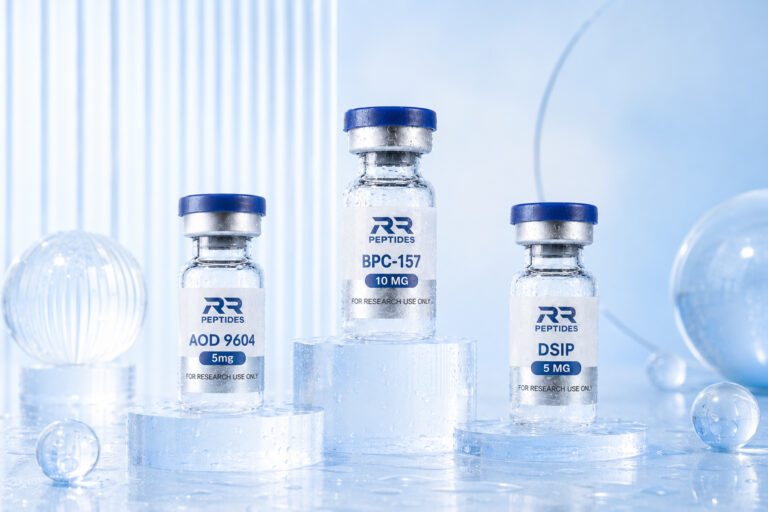
For laboratories in Canada, RR Peptides offers research-oriented product information to review alongside evidence, identity records, and institutional requirements. Explore its catalog when evaluating materials for legitimate laboratory work. This guide reviews ipamorelin research covering mechanisms, study design, outcomes, and distinctions between findings and hypotheses.
Ipamorelin is a synthetic pentapeptide described in the scientific literature as Aib-His-D-2-Nal-D-Phe-Lys-NH2. It belongs to a class of growth hormone secretagogues, compounds investigated for their capacity to stimulate endogenous GH release. Its molecular structure is distinct from native ghrelin, the stomach-derived hormone that normally activates the ghrelin receptor.
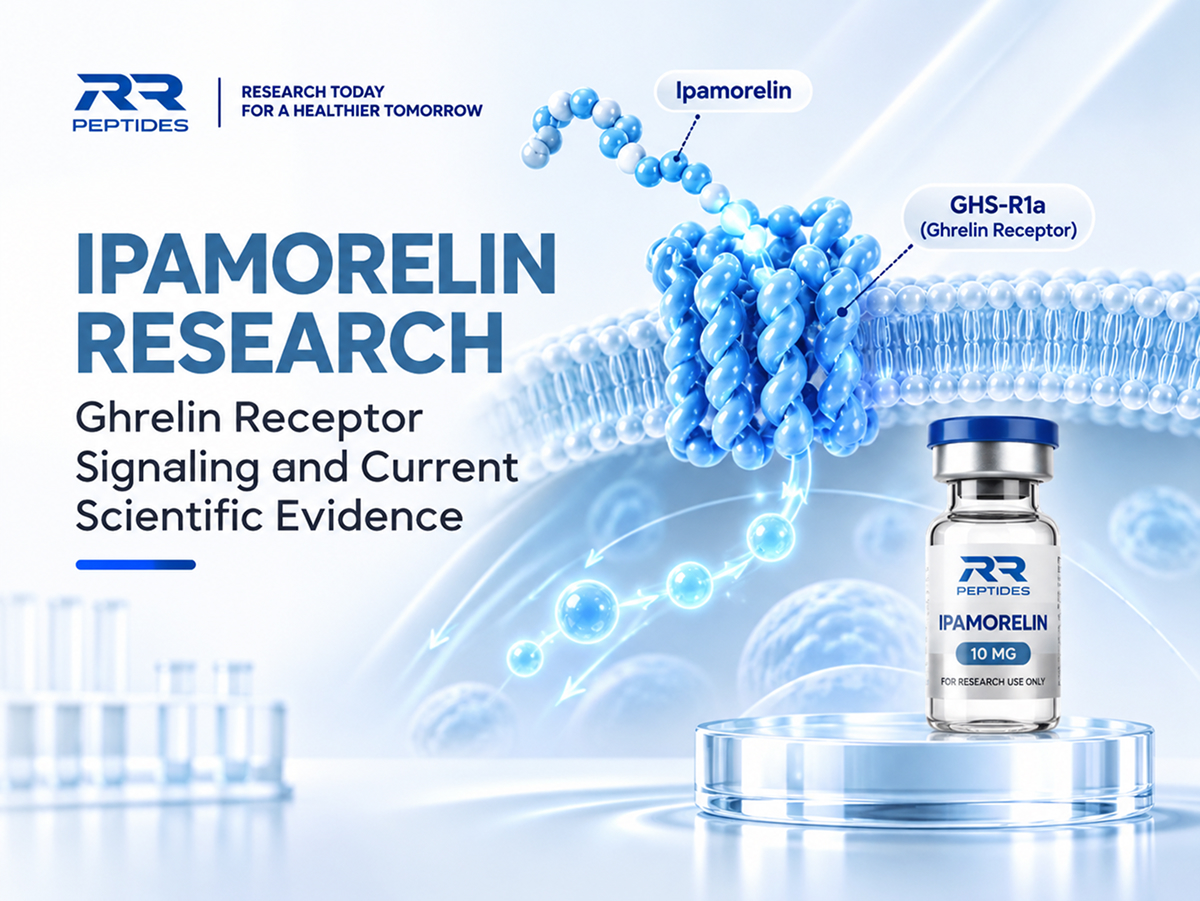
In ipamorelin research, investigators focus on the receptor commonly called GHS-R1a, a G protein-coupled receptor expressed in relevant endocrine and neural tissues. Activation can influence GH secretion from pituitary somatotrophs. This is different from activating the growth hormone-releasing hormone receptor, even though both systems can converge on pituitary hormone output.
Three distinctions guide interpretation:
Receptor identity: Different receptors initiate different intracellular signaling cascades.
Measured endpoint: Mechanistic similarity in the final hormone measurement does not demonstrate identical receptor behavior.
Biological interpretation: Equivalent GH readings do not necessarily imply equivalent physiological consequences.
What the Original Discovery Study Established
A 1998 investigation by Raun and colleagues characterized ipamorelin using cellular assays and animal models. In rats and swine, the compound stimulated GH release. Comparisons with other secretagogues suggested relative GH selectivity in these models.
Notably, the swine experiments found that ipamorelin did not increase adrenocorticotropic hormone (ACTH) or cortisol significantly beyond the responses observed with growth hormone-releasing hormone. Other tested secretagogues produced clearer ACTH and cortisol responses. This observation helped establish interest in ipamorelin research, but it does not prove that endocrine effects are exclusively limited to GH in humans.
Scientific feature
What was investigated
Important boundary
Peptide identity
Synthetic five-residue sequence
Identity must be verified for each sample
Primary pharmacology
Growth hormone secretagogue activity
Does not imply direct GH receptor activation
Experimental systems
Cell assays, rats, and swine
Animal selectivity cannot establish human safety
Endocrine comparison
GH alongside ACTH and cortisol
Findings depend on species and study conditions
Why It Remains Scientifically Relevant
Ipamorelin research also illustrates the limits of using short-term biochemical changes to predict long-term outcomes. Three evidence levels deserve separate attention:
Receptor agonism: Does stimulation occur at the intended molecular target?
Pituitary response: How does stimulation translate into a timed endocrine response across experimental settings?
Functional benefit: Has a meaningful outcome been measured, rather than inferred from hormone changes?
Explore ghrelin receptor signaling and growth hormone regulation in laboratory research with Ipamorelin 10mg, available at RR Peptides.
Which Areas of Ipamorelin Research Are Most Common?
Receptor Pharmacology and Selectivity
One major area of ipamorelin research is the relationship between receptor activation and downstream One major area of ipamorelin research is the relationship between receptor activation and downstream pituitary secretion. Researchers commonly compare candidate agonists against characterized receptor ligands to evaluate their activity. Additionally, antagonist controls help determine whether blocking the expected receptor alters the observed response, while intracellular assays measure signaling changes following exposure. Together, these approaches help distinguish receptor-related effects from nonspecific cellular responses before drawing conclusions about GH release.
Selectivity is especially important because a compound may favor GH release in one assay while affecting other signaling networks under different conditions. Therefore, findings from animal studies suggest relative selectivity rather than absolute hormone specificity.
Endocrine Timing and Pharmacokinetics
A 1999 human volunteer study by Gobburu and colleagues examined ipamorelin concentrations and GH responses after controlled intravenous exposure. Key observations included:
Pharmacokinetics: A model-estimated terminal half-life of approximately two hours.
GH response: A peak at about 0.67 hours, followed by a decline.
Scope: Findings specific to the studied conditions, not predictions for other routes or preparations.
For Ipamorelin research, exposure and effect are distinct timelines. The presence of measurable compound does not guarantee continuous GH release. Investigators must consider receptor responsiveness, secretory stores, feedback, and the natural pulsatility of GH.
Gastrointestinal Motility as a Separate Question
Ghrelin-receptor signaling has also been investigated in gastrointestinal motor function. A randomized, double-blind, placebo-controlled phase II trial explored ipamorelin after bowel resection. Its 2014 publication reported:
Ipamorelin group: Median 25.3 hours to tolerate a standardized meal.
Placebo group: Median 32.6 hours to tolerate the same meal.
Statistical analysis: The difference was not significant (p = 0.15).
For ipamorelin research, a numerical difference does not establish clinical efficacy. The investigators reported no significant differences in key or secondary efficacy analyses. The trial should not be portrayed as proof that the compound treats postoperative ileus.
Evidence by Research Area
Research area
Typical model
Current evidentiary position
GH secretion
Animal experiments and healthy volunteers
Short-term endocrine response demonstrated
Receptor signaling
Cellular and mechanistic models
GHS-R pathway provides biological rationale
Hormone selectivity
Mainly comparative preclinical experiments
Context-dependent, not an absolute guarantee
Gastrointestinal recovery
Randomized phase II patient trial
Primary efficacy difference not significant
Athletic or anti-aging outcomes
Claims often made outside controlled evidence
Clinical benefits not established
These categories ground ipamorelin research in observations rather than promotional claims.
The ghrelin receptor GHS-R1a belongs to the G protein-coupled receptor family. In commonly described models, the signaling sequence involves:
Receptor engagement: Ligand interaction with GHS-R1a.
G protein signaling: Activation of Gq/11-related processes.
Second messengers: Phospholipase C and inositol trisphosphate signaling.
Cellular response: Intracellular calcium mobilization that can contribute to secretion.
Other pathways and receptor interactions have also been described. Their importance varies by cellular context.
Ipamorelin research uses this established receptor biology as a mechanistic framework. However, signaling findings for native ghrelin or another agonist should not automatically be attributed to ipamorelin without compound-specific testing. Demonstrating receptor binding, calcium mobilization, and GH secretion requires separate measurements.
From Receptor Signal to Pituitary Output
Pituitary somatotrophs synthesize and store GH in secretory granules. Stimulatory pathways can promote hormone release, while hypothalamic somatostatin and other feedback signals influence the overall response. Growth hormone-releasing hormone activates a separate receptor, generally linked to cAMP signaling. These systems may interact at the level of the pituitary without sharing an identical initial mechanism.
A robust ipamorelin research model separates three questions:
Does the observed response depend on the intended receptor?
Are the pituitary cells competent to synthesize and release GH?
Does the effect change over time?
One elevated GH measurement cannot resolve all three questions.
Designing Meaningful Endocrine Experiments
A useful framework moves from molecular confirmation to biologically relevant endpoints:
Verify the identity and purity of the tested peptide using appropriate analytical methods.
Confirm receptor expression and establish baseline behavior in the selected model.
Use suitable vehicle, comparator, and receptor-specific controls where scientifically justified.
Record intracellular signals separately from secreted hormone concentrations.
Collect time-resolved observations and document variability across replicates.
State whether conclusions concern cells, animals, or human participants.
For ipamorelin research, this sequence prevents investigators from treating a downstream hormone increase as definitive proof of every proposed molecular step. It also makes negative results easier to interpret.
Why Human and Animal Models Differ
Species may differ in endocrine regulation, receptor expression, feedback sensitivity, and circulating hormone dynamics. An ACTH or cortisol finding in swine cannot be assumed to apply unchanged to human volunteers. Similarly, healthy participants with an intact pituitary axis differ from patients with endocrine disease.
Ipamorelin research gains value when authors define the model’s limits before extrapolating. Combining cellular, preclinical, and human data can build a coherent hypothesis, but it does not erase the differences between those forms of evidence.
Explore ghrelin receptor signaling and growth hormone regulation in laboratory research with Ipamorelin 10mg, available at RR Peptides.
What Outcomes Are Measured in Ipamorelin Research?
GH Concentrations and Pulse Characteristics
GH is a central measurement because the compound was developed as a secretagogue. Yet GH concentrations change episodically, sometimes substantially within short periods. Researchers must distinguish a treatment-associated increase from ordinary pulse timing through suitable controls, repeated observations, and appropriate statistical analysis.
In ipamorelin research, peak GH concentration, time to peak, and integrated GH exposure each answer different questions. None should be described as a direct measurement of muscle growth or improved recovery.
Drug Exposure and Hormonal Response
Pharmacokinetic measurements characterize how the compound appears and declines in circulation. Pharmacodynamic measurements characterize its biological effects. A combined analysis can evaluate whether changing concentrations correspond to changes in GH output, but the relationship may be nonlinear or variable between individuals.
Measurement
Main purpose
Interpretation caution
Plasma ipamorelin concentration
Characterize exposure
Requires selective assay validation
Terminal half-life
Estimate terminal concentration decline
Does not equal duration of GH release
GH peak concentration
Describe maximum observed endocrine response
Depends heavily on sampling times
GH area under the curve
Estimate integrated hormone exposure
Does not establish clinical benefit
ACTH and cortisol
Explore additional endocrine responses
Selectivity varies by model and conditions
IGF-I
Assess downstream axis activity when measured
Cannot substitute for GH pulse analysis
Functional clinical endpoints
Evaluate a specified clinical hypothesis
Require adequately powered controlled studies
Interpreting the 1999 Volunteer Findings
The human study reported dose-proportional pharmacokinetics across its analyzed exposure range and characterized an episodic GH response with a population model. Individual variation in pharmacodynamic parameters was greater than variation in pharmacokinetic parameters. This is an important reminder for ipamorelin research: similar exposure does not guarantee identical hormone output.
The study involved healthy male volunteers and a controlled experimental route. It did not establish an evidence-based consumer dosing schedule, therapeutic indication, or long-term safety profile.
Outcomes That Require Additional Evidence
Claims in these areas require validated endpoints and appropriate clinical trials:
Body composition: Lean mass and fat loss require direct measurements.
Daily functioning: Sleep quality and physical recovery require defined outcomes.
Long-term health: Longevity claims demand evidence that is not available from short-term GH responses.
For Ipamorelin research, surrogate biomarkers cannot replace meaningful clinical endpoints.
A strong report separates what was observed, what is biologically plausible, and what remains untested. Readers should be able to identify the endpoint without confusing it with a proposed benefit.
An endocrine study may also measure IGF-I as a downstream marker of GH-axis activity, but the presence of this assay should not be assumed from a paper’s title. Investigators need to verify which endpoints were actually collected. Peripheral IGF-I responses can vary with nutritional status, age, and other physiological factors.
Explore ghrelin receptor signaling and growth hormone regulation in laboratory research with Ipamorelin 10mg, available at RR Peptides.
What Are the Current Limitations of Ipamorelin Evidence?
Limited Clinical Breadth
The literature includes foundational pharmacology, a short-term volunteer study, and investigations of specific clinical hypotheses. However, these do not create a comprehensive evidence base across different ages, diseases, exposure patterns, and long-term outcomes. Small studies may also miss uncommon adverse events.
Ipamorelin research must distinguish experimental endocrine activity from clinical effectiveness. The postoperative ileus trial offers a useful example: despite a numerical difference in meal tolerance, the primary endpoint was not statistically significant. Negative or inconclusive trials are essential evidence, not details to omit.
Selectivity Is Not a Safety Certificate
The early observation of comparatively selective GH release in animals does not establish freedom from cardiovascular, metabolic, endocrine, or other risks. Receptor distribution, feedback, and repeated exposure may complicate interpretation. Long-term effects cannot be deduced from a brief GH measurement.
Before evaluating ipamorelin research claims, ask these questions:
Was the molecule independently identified, with its formulation and purity documented?
Does the study test the exact claim being made, or only a related biomarker?
Are control groups, sample size, and follow-up sufficient?
Were results statistically significant and clinically meaningful?
Were uncertainties and adverse events reported transparently?
Canadian Regulatory Context
Health Canada explicitly listed ipamorelin among unauthorized injectable peptide drugs in its April 9, 2026 safety advisory. It warned that unauthorized products have not been assessed for safety, efficacy, and quality and should not be used for human consumption. An additional November 6, 2026 advisory described bacterial contamination detected in certain unauthorized injectable peptide products sold online.
For Canadian ipamorelin research, these warnings reinforce the need for legitimate procurement, institutional oversight, accurate material identification, and compliance with applicable laws. A label stating “for research use only” does not automatically exempt a product from regulatory requirements. A certificate of analysis also cannot establish clinical authorization.
Priorities for Future Studies
Future ipamorelin research would benefit from four priorities:
Replication: Independent receptor experiments that establish reproducibility.
Endocrine endpoints: Clearly defined hormone measurements and sampling windows.
Exposure analysis: Robust pharmacokinetics with documented assays and uncertainty.
Clinical design: Controlled studies addressing specific questions rather than generalized benefits.
Researchers should report negative findings, avoid extrapolating between models, and document participant characteristics and statistical uncertainty. This improves comparability between studies using different analytical methods.
Publication transparency also matters in ipamorelin research. A clear report identifies participants, analysis plan, and missing data. Such details make hormone curves interpretable and allow laboratories to test whether effects are reproducible rather than statistical artifacts of selective reporting.
SEE MORE:
Ipamorelin Mechanism of Action: Ghrelin Receptor Activity and Endocrine Signaling
Ipamorelin and Ghrelin Receptor Research: GHS-R1a Signaling Explained
Ipamorelin Growth Hormone Signaling Research: Endocrine Pathways and Study Models
Ipamorelin Receptor Selectivity Research: GHS-R1a Activity and Signaling Specificity
Ipamorelin Storage and Stability: Laboratory Conditions and Sample IntegritY
No. Ipamorelin is a synthetic growth hormone secretagogue. It stimulates pathways associated with endogenous GH release rather than supplying GH itself.
Which Receptor Is Central to Its Mechanism?
The growth hormone secretagogue receptor GHS-R1a is the principal receptor associated with its pharmacology. This differs from the receptor for growth hormone-releasing hormone.
Has Human Research Demonstrated GH Release?
Yes. A controlled 1999 study in healthy male volunteers observed a transient GH response and characterized the relationship between compound exposure and hormone release. It did not establish long-term clinical benefit.
Is Ipamorelin Proven to Improve Postoperative Recovery?
No. A published phase II trial found no statistically significant improvement in its primary efficacy endpoint compared with placebo, despite a numerical difference.
Does Selective GH Release Mean There Are No Side Effects?
No. Selectivity observations from particular experimental models cannot establish comprehensive human safety, especially with repeated exposure or longer follow-up.
Can Canadian Consumers Use Research-Labeled Ipamorelin?
Health Canada warns against unauthorized injectable peptides, explicitly including ipamorelin. Research labeling does not authorize human use or eliminate legal requirements.
What Is the Most Important Evidence Gap?
Long-term controlled human evidence linking receptor and hormone responses to clearly defined clinical outcomes remains insufficient. Ipamorelin research should not substitute preliminary mechanistic evidence for demonstrated patient benefit.
Conclusion
Ipamorelin research provides a scientifically useful case study in ghrelin-receptor signaling, pituitary GH secretion, and the distinction between biochemical activity and clinical outcomes. Early studies established secretagogue activity, and human experiments demonstrated short-term endocrine responses. However, the available evidence does not justify claims of proven anti-aging, bodybuilding, or recovery benefits.
For legitimate Canadian laboratory projects, explore RR Peptides for research-focused product information while independently confirming analytical documentation, institutional requirements, and Health Canada obligations. Sound scientific conclusions depend on verified material identity, carefully selected endpoints, and transparent reporting.
Ultimately, ipamorelin research is strongest when it identifies exactly what a study demonstrates and what remains uncertain. That approach informs future experiments without turning preliminary findings into medical promises.
Disclaimer: All products and compounds discussed are intended strictly for laboratory and research purposes. This article is provided for educational and informational purposes only. This article is not medical advice, therapeutic guidance, or instructions for human administration.
×
Subscribe & Get 10% Off!
Enter your email address below to subscribe to our newsletter and receive an instant 10% OFF discount coupon code sent directly to your inbox!
Thank you for subscribing! Your 10% discount coupon has been sent to your email. Please check your inbox!