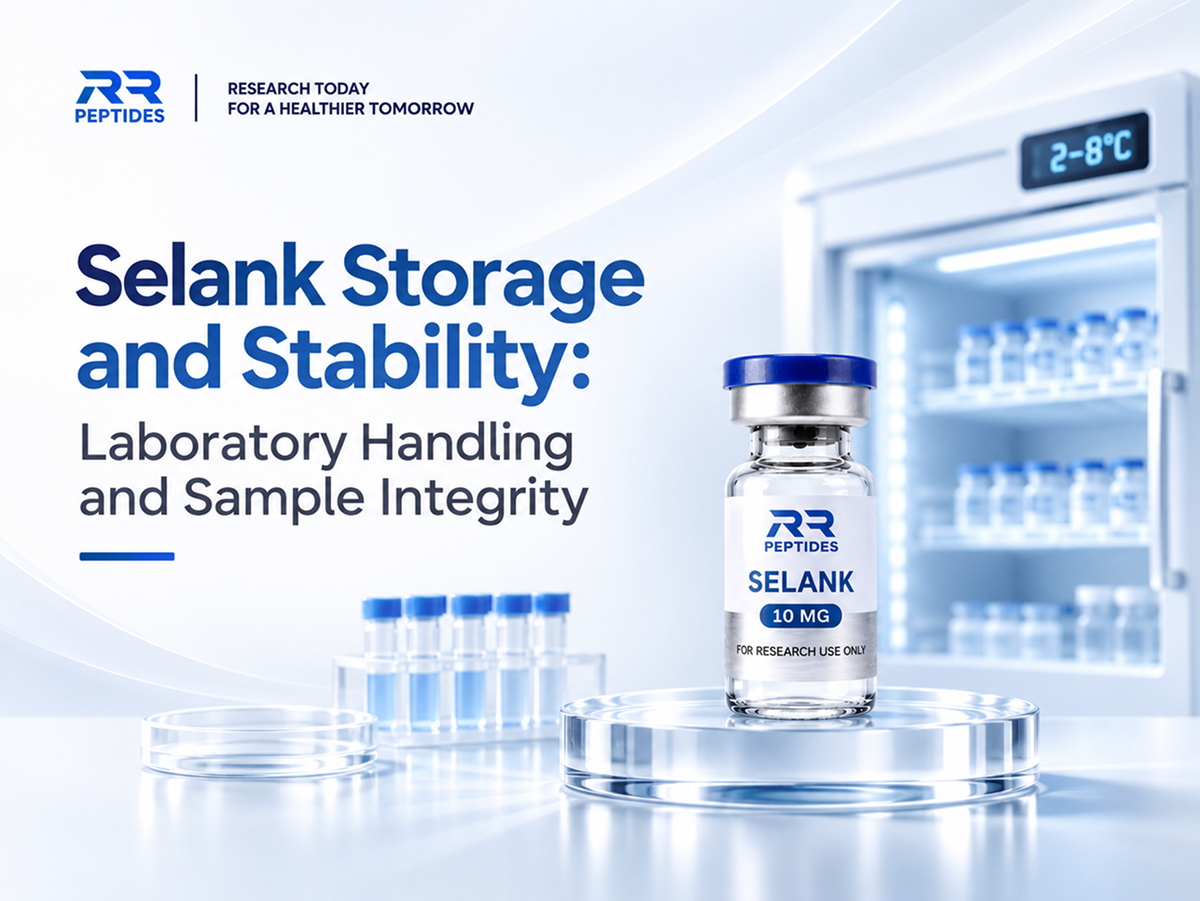
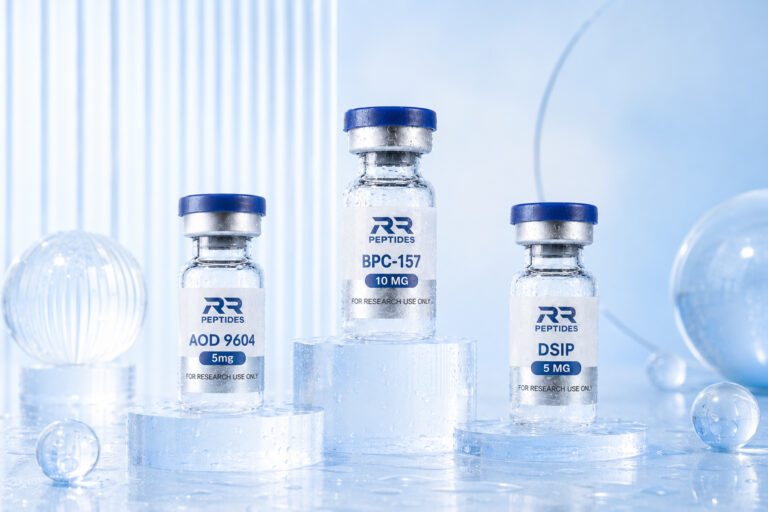
A peptide sample can look unchanged while its chemical composition changes. Moisture, unsuitable temperatures, and repeated handling may gradually affect the material that researchers expect to measure. When an assay produces an unexpected result, sample integrity should be investigated before drawing biological conclusions.
Selank storage and stability is therefore more than a question of choosing a refrigerator or freezer. It involves protecting a defined peptide, documenting its history, and verifying that the material remains suitable for a particular experiment. Selank is a synthetic heptapeptide with the sequence Thr-Lys-Pro-Arg-Pro-Gly-Pro, abbreviated TKPRPGP. Its stability cannot be inferred from appearance alone.
For Canadian laboratories planning investigations, RR Peptides offers research-focused product information and analytical documentation. Review its specifications before selecting an approved handling plan.
For Selank storage and stability, the central question is whether the same identified material would produce comparable measurements after storage. Reliable answers require records, analytical evidence, and procedures tailored to the study.
Two distinct quality dimensions deserve attention:
Chemical stability: Whether the intended peptide structure remains intact over time.
Physical stability: Changes such as precipitation, adsorption onto containers, or altered dissolution behaviour.
A sample can pass a visual inspection yet contain impurities that interfere with quantitative measurements. Conversely, visible particles do not identify which chemical reaction occurred.
Selank storage and stability should be evaluated against the intended analytical method. A small amount of degradation may be important for a sensitive receptor experiment, even when the principal peptide peak remains dominant. Acceptance criteria should be defined before testing, rather than invented after a result appears.
Sequence Matters, but Does Not Tell the Whole Story
The Selank sequence contains threonine, lysine, proline, arginine, and glycine residues. It lacks several residues frequently associated with particular peptide degradation reactions, including methionine and cysteine. However, this does not make Selank immune to hydrolysis, adsorption, contamination, or formulation-dependent changes. Storage behaviour depends on the complete product, not just its amino acid sequence.
Material-specific variables include:
Composition: Counterions, excipients, and starting purity.
Packaging: Container materials and seal integrity.
Production: Manufacturing conditions and residual moisture.
For Selank storage and stability, a certificate of analysis provides a useful starting point, but a release test does not establish how long a specific lot will remain within specification.
Why the Sample Form Changes the Risk
Lyophilized material and prepared laboratory solutions face different conditions. Freeze-drying removes much of the water that enables certain degradation processes. Once dissolved, the peptide interacts with a solvent, dissolved oxygen, surfaces, and any buffer components. Neither form has a universal expiration date.
Factor
Potential effect
Practical research consideration
Water exposure
Supports moisture-related degradation
Protect dry material from condensation
Temperature
Changes reaction rates and physical behaviour
Follow validated, lot-specific conditions
Solution pH
May alter chemical degradation pathways
Verify compatibility with the assay
Container surface
Can cause nonspecific peptide adsorption
Evaluate suitable laboratory vessels
Repeated access
Adds handling and contamination opportunities
Minimize openings and transfers
A useful Selank storage and stability plan begins with identifying the material’s form, packaging, and intended period of use. Researchers should then match those details to available supplier evidence and their own stability observations.
Another challenge in Selank storage and stability is distinguishing genuine molecular changes from analytical variation. A different chromatographic peak area may reflect sample preparation, detector performance, or incomplete recovery rather than degradation.
Explore neurological signaling and neurotransmitter research at RR Peptides with Selank 10mg.
Lyophilization generally improves the storage practicality of many research peptides, but the recommended temperature depends on the product and its validation. Published peptide-handling guidance commonly discusses frozen storage around minus twenty degrees Celsius or colder for longer-term preservation. That is a general laboratory approach, not a verified Selank-specific shelf-life claim.
For Selank storage and stability, the product label, accompanying documentation, and institutional procedures should take precedence over generic advice. If a supplier has not supplied validated storage conditions, researchers should avoid claiming that a particular temperature guarantees potency for a fixed number of months.
Protect the Dry Vial From Moisture
Cold containers can accumulate condensation when opened in humid air. The resulting water may compromise the advantages of lyophilization. A sensible laboratory practice is to allow a sealed, cold vial to equilibrate toward room temperature before opening it, when compatible with the approved procedure. This reduces direct exposure of cold powder to atmospheric moisture.
Several habits can improve sample management:
Keep containers sealed: Limit exposure to ambient air between authorized laboratory operations.
Use appropriate secondary packaging: Protect against accidental breakage and environmental fluctuations.
Track every opening: Record dates, responsible personnel, and any unusual observations.
Avoid unnecessary transfers: Each transfer creates opportunities for material loss or contamination.
Separate inventory: Store reference material apart from frequently accessed working material.
Selank storage and stability depends on consistent handling, not merely a low freezer display reading. An incorrectly closed vial can undermine otherwise appropriate environmental controls.
Freezer Organization and Canadian Conditions
Canadian laboratories may receive shipments during summer heat, winter cold, or long-distance transportation between provinces. External weather alone cannot confirm what temperature a vial experienced inside its packaging. A shipment described as temperature controlled should be assessed against documented packaging performance and any available monitoring records.
For Selank storage and stability, receiving staff should inspect packaging, identify unexpected delays, and record excursions. Quarantine questionable material until a qualified person reviews its suitability. Delivery delays alone do not prove degradation.
Selank storage and stability also requires access controls and inventory reconciliation.
How Do Temperature, Light, and Moisture Affect Selank?
Temperature Changes Reaction Rates
Temperature can influence sample quality in several ways:
Warm conditions: Higher temperatures can accelerate chemical reactions, although the extent varies by peptide and formulation.
Frozen storage: Freezing can slow degradation in some preparations, but it does not guarantee that every solution remains unchanged.
Physical changes: Freezing may alter solute distribution or create concentration gradients in certain mixtures.
Selank storage and stability should be tested under conditions reflecting actual storage and analytical workflows. A single temperature reading at the time of analysis does not describe previous exposure. Continuous monitoring or documented minimum and maximum readings can reveal events that routine checks miss.
Light Exposure and Oxygen
Some peptide sequences contain amino acids particularly vulnerable to photooxidation. Selank lacks certain commonly discussed light-sensitive residues, but its complete formulation may still require protection. Without sequence-specific photostability evidence, laboratories should not claim that ordinary lighting either definitely damages Selank or leaves it unaffected.
Reducing unnecessary light and air exposure is a reasonable precaution during Selank storage and stability studies. Amber containers or protective secondary packaging may be useful when compatible with the analytical method. Any effect should ultimately be established by testing rather than assumed from the packaging colour.
Moisture and the Dry-to-Solution Transition
Water can enable reactions that occur more slowly in dry material. After dissolution, buffer composition, pH, concentration, and storage duration become especially relevant. General peptide literature recommends minimizing repeated freeze-thaw cycles, but no universal number of safe cycles can be assigned to every Selank preparation.
Environmental exposure
What researchers should document
What cannot be assumed
Warm storage
Duration and measured temperature
Immediate loss of all activity
Freezing
Temperature and number of cycles
Unlimited stability
Room lighting
Exposure time and container type
Proven Selank photodegradation
Humid air
Opening conditions and seal integrity
A predictable degradation percentage
Aqueous storage
Buffer, pH, concentration, and time
A universal solution shelf life
For Selank storage and stability, the most useful question is not whether a condition sounds safe, but whether the resulting sample still meets prespecified quality criteria.
When assessing Selank storage and stability, distinguish preventive precautions from experimentally demonstrated vulnerabilities. That distinction allows researchers to use conservative handling practices without claiming that every environmental exposure causes measurable peptide damage.
Explore neurological signaling and neurotransmitter research at RR Peptides with Selank 10mg.
What Handling Practices Help Protect Sample Quality?
Build a Traceable Receiving Workflow
Good laboratory handling begins before a container enters storage. Researchers should compare the received item with procurement records and examine available documentation. Lot identity, stated content, packaging integrity, and any shipping conditions should be captured in the laboratory record.
A practical receiving sequence includes:
Confirm the identity and lot number against the purchase record.
Inspect the outer package and vial without opening the material unnecessarily.
Record arrival time, package condition, and temperature-monitoring evidence, if available.
Review the supplier’s storage statement and analytical documentation.
Assign a documented storage location and internal tracking identifier.
Escalate discrepancies before the material is released for experiments.
Selank storage and stability improves when every later analytical result can be connected to an identifiable lot and handling history. Without traceability, laboratories may mistake a compromised sample for a biological finding.
Plan Laboratory Solutions Carefully
When a protocol requires a peptide solution, the solvent and buffer should be selected for the validated analytical purpose. Solubility, pH, ionic strength, and assay compatibility all matter. Generic preparation advice should never be treated as an instruction for human or veterinary administration.
Researchers should prepare only the quantities required by approved experiments and consider single-use analytical aliquots when justified. This can reduce repeated freeze-thaw events and repeated contact with the same container. However, aliquoting also introduces transfer losses, so the procedure should be qualified for the assay.
Selank storage and stability can be influenced by adsorption to glass or plastic. Low-binding vessels may help in some workflows, but performance varies with concentration and solvent composition. Recovery testing is more informative than assuming that any container marketed as low-binding will work identically.
Documentation Is Part of Sample Integrity
An effective log records more than the freezer location. It should capture:
Preparation: Date, solution composition, and container type.
Storage: Temperature history and thaw events.
Accountability: Analyst responsible and changes in sample location.
A clear chain of custody supports subsequent review.
For Selank storage and stability, these records help explain differences between analytical runs. They also support corrective action after an equipment alarm, shipment problem, or unexpected chromatographic result.
A consistent Selank storage and stability workflow should include equipment maintenance records and calibrated monitoring devices. A freezer set point is not equivalent to the actual temperature experienced by every container inside it.
Explore neurological signaling and neurotransmitter research at RR Peptides with Selank 10mg.
A stability study needs an initial benchmark. Researchers may characterize a representative sample near receipt or preparation, using methods appropriate to the intended experiment. Later measurements are then compared against the baseline using predefined acceptance criteria. The design should account for analytical variation and sample preparation effects.
Selank storage and stability cannot be confirmed by a label claim alone. A high initial purity result is valuable, but it does not reveal future degradation kinetics or guarantee that a stored solution remains suitable for an experiment.
Analytical Methods and Their Roles
Reversed-phase high-performance liquid chromatography can separate a principal peptide peak from some related impurities. Liquid chromatography coupled with mass spectrometry can help investigate molecular masses and potential degradation products. Neither technique is automatically stability indicating without suitable method development and validation.
Method
What it can help assess
Important limitation
RP-HPLC
Peak profile and relative purity
Coeluting impurities may be missed
LC-MS
Mass-related identity and degradation signals
Interpretation depends on method performance
Water-content testing
Residual moisture in dry material
Does not measure peptide identity
Visual inspection
Particles or visible changes
Cannot establish chemical purity
Functional assay
Activity in a defined research system
Biological variability may obscure chemical changes
In Selank storage and stability investigations, combining complementary methods often provides stronger evidence than relying on one purity percentage. Researchers should also distinguish chemical degradation from sample loss caused by adsorption or incomplete recovery.
Design Meaningful Stability Time Points
Useful sampling intervals depend on the intended storage duration and experimental workflow. A short analytical study might compare freshly prepared material with samples held under anticipated instrument conditions. Longer investigations may include multiple frozen-storage intervals and documented excursions.
Selank storage and stability experiments should include appropriate replicates, controls, and consistent sample preparation. Comparing results from different methods or instruments without accounting for variability can create misleading trends.
Interpret Deviations Before Reusing Material
Unexpected findings warrant investigation:
Chromatographic changes: Review new peaks against baseline profiles.
Concentration loss: Check recovery, transfers, and adsorption.
Temperature excursions: Examine handling records and instrument suitability.
Before attributing a result to degradation, review blank samples and method precision.
A sound Selank storage and stability decision uses predefined specifications and a documented quality review. If suitability cannot be established, the material should not be used in experiments that depend on reliable identity or concentration.
The purpose of Selank storage and stability monitoring is to protect interpretability. If sample concentration changes unexpectedly, researchers may need to repeat chemical characterization before comparing downstream biological results across experimental groups.
Does Lyophilized Selank Have a Universal Shelf Life?
No. Shelf life depends on the specific formulation, packaging, storage conditions, and supporting stability data. General peptide recommendations cannot establish an expiration date for every Selank lot.
Is Freezing Always Better Than Refrigeration?
Not necessarily. Frozen storage is common for long-term peptide preservation, but appropriate conditions depend on the material and validated procedure. Solutions may respond differently from dry powders.
Should a Cold Vial Be Opened Immediately?
Opening a cold container in humid air can encourage condensation. Where the approved procedure permits, allow the sealed container to equilibrate before opening.
Can Researchers Judge Stability From Appearance?
No. A clear solution or unchanged powder can still contain chemical impurities. Analytical testing is necessary when sample integrity matters to an experiment.
Does a Certificate of Analysis Prove Long-Term Stability?
No. A certificate generally documents selected characteristics at a defined testing point. Long-term stability requires evidence covering relevant conditions and durations.
What Should Canadian Laboratories Check Before Procurement?
Review applicable Health Canada requirements, institutional authorization, supplier documentation, and product classification. A research-use label does not automatically make a product legal to import or sell in Canada.
Are These Guidelines Suitable for Human Preparation?
No. This discussion concerns laboratory sample integrity, not injection, dosing, or clinical preparation. Research materials should not be represented as authorized medicines.
In Selank storage and stability assessments, investigators should record both acceptable and unacceptable results. Documenting failures helps improve future protocols and prevents unsupported assumptions about how similar batches will behave.
Conclusion
Selank storage and stability depends on more than placing a vial in cold storage. Material form, moisture control, documented temperatures, careful handling, and analytical verification all contribute to reliable experiments. Most importantly, general peptide recommendations should not be mistaken for validated Selank-specific expiration dates.
For Canadian laboratories, sound practice combines traceable receiving procedures, fit-for-purpose testing, and awareness of applicable regulatory requirements. Explore RR Peptides for research product information and available analytical documentation, then confirm that the material and handling plan meet institutional standards for each planned experiment.
Ultimately, Selank storage and stability is a quality-control responsibility shared by procurement, laboratory personnel, and analysts. Consistent documentation makes results easier to interpret and reproduce.
Disclaimer: All products and compounds discussed are intended strictly for laboratory and research purposes. This article is provided for educational and informational purposes only. This article is not medical advice, therapeutic guidance, or instructions for human administration.
×
Subscribe & Get 10% Off!
Enter your email address below to subscribe to our newsletter and receive an instant 10% OFF discount coupon code sent directly to your inbox!
Thank you for subscribing! Your 10% discount coupon has been sent to your email. Please check your inbox!