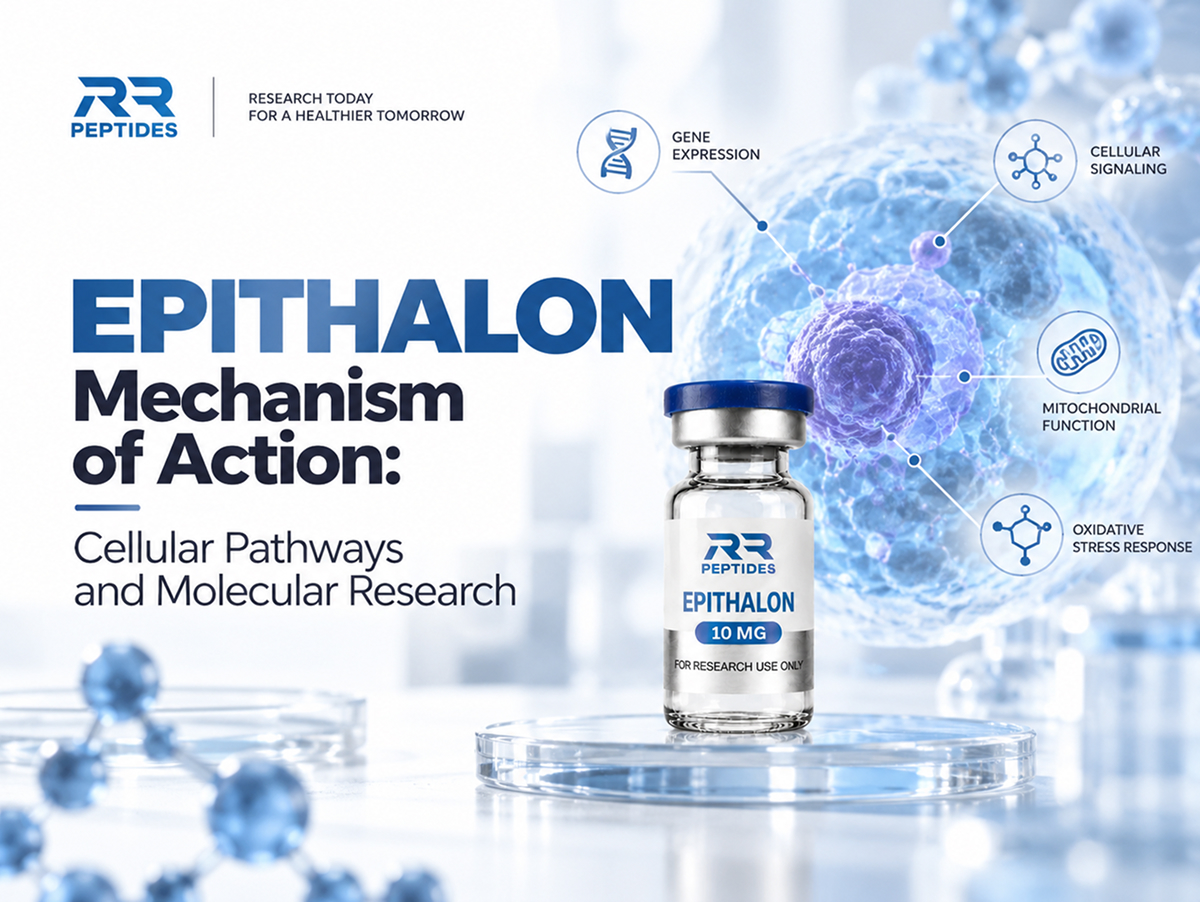
Researchers investigating these processes frequently examine short peptides that may interact with cellular regulatory systems. Epithalon, also called Epitalon, has attracted scientific interest because of experimental findings involving telomerase activity, cellular senescence, and gene expression.
The Epithalon mechanism of action remains an active research question rather than a fully established biological pathway. Although several laboratory studies have reported changes in molecular markers following experimental exposure, researchers have not conclusively identified a single receptor or signaling cascade responsible for all reported effects.
Understanding the Epithalon mechanism of action requires separating observations from proposed explanations. Changes in telomerase activity, for example, do not automatically demonstrate longer cellular lifespan or improved organism health.
For Canadian laboratories exploring peptide biology, RR Peptides offers research-focused compound information that can support initial material evaluation. Researchers should independently review analytical documentation and institutional requirements before beginning experiments.
This article examines the Epithalon mechanism of action through cellular pathways, molecular evidence, experimental limitations, and unanswered scientific questions.
How Is Epithalon Thought to Act at the Cellular Level?
Epithalon is a synthetic tetrapeptide composed of alanine, glutamate, aspartate, and glycine, commonly represented by the sequence Ala-Glu-Asp-Gly.
The Epithalon mechanism of action has been investigated primarily through experimental observations involving cultured cells, molecular markers, and selected animal models. However, the precise molecular interactions responsible for these findings remain incompletely characterized.
Molecular Structure and Research Background
Epithalon is associated with research originating from investigations into pineal-derived peptide preparations and synthetic peptide regulators. Importantly, Epithalon is a defined synthetic tetrapeptide, whereas Epithalamin refers to a different, biologically derived peptide preparation.
The Epithalon mechanism of action must therefore be evaluated using studies that clearly identify the compound, experimental conditions, and analytical methods.
Cellular Entry and Molecular Interactions
However, a specific cellular entry pathway for Epithalon has not been conclusively established across biological systems.
Several questions remain important:
Cellular uptake: Whether and how the peptide enters different cell types.
Intracellular distribution: Which cellular compartments are exposed to the compound.
Molecular binding: Whether direct interactions occur with specific regulatory targets.
Biological specificity: Whether observed changes are unique to Epithalon.
Exposure dependence: How experimental conditions influence measurable responses.
Why Cellular Context Matters
Different cell types possess distinct regulatory systems, metabolic requirements, and responses to stress.
The Epithalon mechanism of action may therefore appear different depending on cell identity, baseline physiological conditions, and the endpoints selected for analysis.
Research Overview
Research characteristic
Scientific relevance
Current limitation
Tetrapeptide structure
Defines molecular identity
Does not establish a target
Telomerase observations
Suggests possible regulatory effects
Findings are model-dependent
Gene expression changes
Indicates altered cellular activity
Direct causation remains uncertain
Chromatin-related hypotheses
Suggests nuclear regulatory interactions
Requires independent validation
Cellular aging models
Provide experimental context
Cannot establish human longevity
Explore cellular aging pathways and telomerase research with RR Peptides’ research-grade Epithalon 10mg.
Which Molecular Pathways Are Associated With Epithalon?
Several molecular processes have been discussed in connection with Epithalon, particularly telomerase regulation, gene expression, chromatin organization, and cellular stress responses.
Nevertheless, the Epithalon mechanism of action should not be represented as a confirmed network of signaling pathways. Much of the available evidence remains exploratory, and different studies have investigated different biological outcomes.
Telomerase Activity and Telomere Biology
Telomeres are repetitive DNA sequences and associated proteins located at chromosome ends. They help protect chromosome integrity during cellular replication.
Some published cell-culture investigations have reported changes in telomerase activity following Epithalon exposure.
However, researchers must distinguish several related outcomes:
Increased telomerase activity does not necessarily establish telomere elongation.
Telomere elongation does not automatically demonstrate improved cellular function.
Cellular replication changes do not establish increased organism lifespan.
Telomerase regulation may have different implications across normal and abnormal cells.
Because telomerase is also relevant to cancer biology, its activity cannot be interpreted as universally beneficial.
Gene Expression and Regulatory Processes
Some investigations involving short regulatory peptides have reported changes in gene expression or interactions with nuclear components.
The Epithalon mechanism of action has consequently been discussed in relation to transcriptional regulation and cellular differentiation.
However, observing altered gene expression does not prove that Epithalon directly binds DNA or controls transcription.
Chromatin Organization
Chromatin consists of DNA associated with histones and other regulatory proteins.
Researchers have explored whether certain short peptides interact with chromatin-related structures or influence regulatory activity.
These hypotheses remain important to the Epithalon mechanism of action, but the evidence should be interpreted cautiously.
Demonstrating a molecular interaction under simplified laboratory conditions does not establish that the same interaction produces a functional response inside living organisms.
Oxidative Stress and Cellular Maintenance
Oxidative stress occurs when reactive chemical species and cellular protective systems become imbalanced. Researchers studying aging-related processes frequently measure oxidative damage, antioxidant responses, and mitochondrial activity.
Although some peptide studies have investigated these outcomes, the Epithalon mechanism of action has not been conclusively established as a direct antioxidant pathway. Any observed change requires appropriate controls to distinguish direct molecular effects from secondary cellular responses.
Cellular regulation involves coordinated interactions among genetic, biochemical, and environmental signals. Researchers studying Epithalon investigate whether experimental exposure influences selected components of these systems.
The Epithalon mechanism of action is especially relevant to questions involving cellular senescence, transcriptional activity, and responses to biological stress.
Cellular Senescence and Replicative Limits
Cellular senescence describes a state in which cells undergo persistent changes associated with growth arrest and altered biological activity.
Some Epithalon investigations have examined cell proliferation and replicative characteristics. However, the Epithalon mechanism of action cannot be established through proliferation measurements alone.
Researchers should evaluate multiple indicators, including:
Cell-cycle activity and growth arrest.
DNA damage response markers.
Senescence-associated enzyme activity.
Changes in cellular morphology.
Expression of relevant regulatory proteins.
Differences in viability and population composition.
These measurements provide a more complete interpretation than relying on a single marker.
Telomere Maintenance Versus Cellular Longevity
Telomere maintenance is one component of chromosome biology, but cellular aging involves many additional processes.
Even when experimental findings suggest altered telomerase activity, researchers must determine whether the response produces sustained changes in telomere length. The Epithalon mechanism of action also requires investigation into whether molecular changes remain detectable after experimental exposure ends.
Transcriptional Regulation and Differentiation
Cell differentiation involves changes in gene expression that establish specialized cellular characteristics. Researchers have explored whether regulatory peptides influence differentiation-related processes or patterns of gene activity.
For the Epithalon mechanism of action, these questions require carefully controlled experiments that compare relevant cell populations and molecular endpoints. A change in transcriptional activity may reflect altered cell composition rather than direct regulation of a particular gene.
Experimental Factors Affecting Interpretation
Cellular responses depend on more than compound identity.
Researchers should consider:
Experimental factor
Potential influence
Cell type
Determines baseline regulatory activity
Passage number
May influence senescence markers
Culture conditions
Affect metabolic and transcriptional responses
Experimental duration
Influences observable molecular changes
Sample purity
Helps identify compound-related effects
Analytical method
Determines measurement reliability
These variables are particularly important when comparing studies performed in different laboratories.
Connecting Molecular Changes With Function
An observed change in a molecular marker does not automatically indicate an improvement in cellular performance.
Researchers should investigate whether biochemical observations correspond with reproducible functional outcomes. The Epithalon mechanism of action becomes more convincing when several independent methods support the same biological interpretation.
For example, telomerase measurements, telomere assessments, and cellular growth characteristics can provide complementary evidence.
What Evidence Supports Proposed Epithalon Mechanisms?
Scientific evidence concerning Epithalon comes from a relatively limited and heterogeneous research literature.
Some publications describe findings involving telomerase activity, cellular regulation, or age-associated experimental outcomes.
However, the Epithalon mechanism of action remains uncertain because many findings require independent replication, stronger mechanistic testing, and broader evaluation across biological models.
Evidence From Cell Culture Studies
Cell culture investigations offer controlled environments for studying molecular changes. One frequently discussed research direction involves observations of telomerase activation in human somatic cell cultures.
These findings are relevant to the Epithalon mechanism of action because they provide measurable molecular endpoints. Nevertheless, several limitations require consideration.
Furthermore, experimental findings may depend on cell type, baseline telomerase activity, exposure conditions, and analytical methodology.
Evidence From Animal Research
Animal experiments can examine relationships among molecular regulation, tissue function, and organism-level outcomes.
Historical research involving Epithalon and related peptide preparations has investigated selected aging-associated biological processes. However, results from different compounds should not be combined without confirming their molecular identities.
The Epithalon mechanism of action also cannot be established solely through changes in animal survival or physiological markers. Such outcomes may reflect multiple biological pathways.
Human Research and Evidence Quality
Human research involving peptide preparations associated with this field has been discussed in scientific literature. However, available reports do not establish a well-characterized clinical mechanism for synthetic Epithalon.
Researchers should distinguish studies of Epithalon from those examining Epithalamin or other peptide mixtures. The Epithalon mechanism of action requires evidence that directly evaluates the defined compound using appropriate experimental methods.
Claims concerning human lifespan extension, disease prevention, or therapeutic effectiveness exceed what can currently be established from the available mechanistic evidence.
How Researchers Evaluate Evidence
A useful evidence assessment considers study design, analytical methods, and reproducibility.
Evidence category
What it can demonstrate
Main limitation
Molecular binding studies
Potential interactions
May lack cellular relevance
Cell culture experiments
Cellular responses
Limited biological complexity
Animal experiments
Tissue and organism responses
Species differences
Human observational reports
Associations in participants
Limited causal interpretation
Controlled clinical studies
Prespecified clinical outcomes
May not establish mechanism
Research Quality Considerations
When reviewing publications, researchers should examine whether investigators clearly describe the experimental compound, control groups, measurement methods, and statistical analysis.
The Epithalon mechanism of action should be evaluated using the totality of available evidence rather than relying on one frequently cited experiment.
For Canadian research institutions, this approach supports transparent scientific reporting and appropriate evaluation of research-grade materials.
Explore cellular aging pathways and telomerase research with RR Peptides’ research-grade Epithalon 10mg.
Which Mechanistic Questions Remain Unresolved?
Despite scientific interest, several fundamental questions about Epithalon remain unanswered.
The Epithalon mechanism of action cannot be considered fully established until researchers identify reproducible molecular targets and demonstrate how those interactions produce specific biological outcomes.
Is There a Defined Molecular Target?
A central unresolved question concerns whether Epithalon interacts directly with a particular receptor, enzyme, or regulatory complex. Some hypotheses emphasize nuclear processes, while others focus on broader cellular regulation.
However, the Epithalon mechanism of action lacks a universally accepted direct molecular target supported across independent experimental systems. Future studies should distinguish direct binding from downstream changes in cellular activity.
How Reproducible Are Telomerase Findings?
Telomerase-related observations remain among the most frequently discussed aspects of Epithalon research.
Nevertheless, researchers need consistent results across independent laboratories, different cell populations, and validated analytical methods.
The Epithalon mechanism of action would be better characterized through experiments that examine both telomerase activity and subsequent telomere changes. These outcomes should be measured separately rather than treated as equivalent.
Are Reported Effects Specific?
Biological responses can arise from experimental stress, differences in culture conditions, or nonspecific interactions. Researchers must establish whether observed effects are attributable to Epithalon itself.
The Epithalon mechanism of action requires carefully selected controls, appropriate comparators, and analytical confirmation of sample identity. Without these safeguards, molecular changes may be incorrectly attributed to the peptide.
What Are the Translational Limitations?
Findings from cultured cells cannot automatically predict responses in animals or humans.
The Epithalon mechanism of action therefore requires additional research before laboratory observations can support conclusions about human physiology.
Priorities for Future Investigation
Several research priorities could strengthen scientific understanding:
Identify and validate potential molecular binding partners.
Replicate telomerase findings across independent cell models.
Determine whether reported gene expression changes are direct or indirect.
Investigate relationships between molecular markers and cellular function.
Improve analytical characterization of research materials.
Establish reproducible methods for assessing long-term cellular outcomes.
Canadian Research and Regulatory Considerations
Canadian laboratories should distinguish experimental peptides from authorized therapeutic products. Researchers should review applicable Health Canada requirements, institutional safety policies, and ethical obligations before conducting relevant studies.
For laboratories considering RR Peptides, available product specifications and analytical documentation can support preliminary research material assessment.
The Epithalon mechanism of action remains a scientific question requiring rigorous investigation, not a basis for unsupported clinical claims.
Discover the latest findings on cellular aging, telomeres, and scientific evidence in Epithalon Research: Cellular Aging, Telomeres, and Current Scientific Evidence.
Epithalon is a synthetic tetrapeptide composed of alanine, glutamate, aspartate, and glycine. It has been investigated in experimental research involving cellular regulation, telomerase activity, and aging-associated biological processes.
What is the proposed Epithalon mechanism of action?
The Epithalon mechanism of action has been discussed in relation to telomerase regulation, gene expression, and possible chromatin-associated processes. However, a definitive molecular target and complete signaling pathway have not been established.
Does Epithalon activate telomerase?
Some laboratory studies have reported increased telomerase activity following experimental exposure. These findings require careful interpretation because outcomes may depend on the cell model and measurement conditions.
Does Epithalon directly extend telomeres?
Telomerase activity and telomere length are related but distinct measurements. Evidence of altered enzyme activity does not independently establish sustained telomere elongation.
Is Epithalon an anti-aging treatment?
Current mechanistic research does not establish Epithalon as a proven anti-aging treatment. Laboratory observations cannot substitute for rigorous clinical evidence demonstrating safety and effectiveness.
How is Epithalon different from Epithalamin?
Epithalon is a defined synthetic tetrapeptide. Epithalamin is a biologically derived peptide preparation containing different components. Research findings involving these materials should not be considered interchangeable.
What laboratory models are used?
Researchers have investigated Epithalon using selected cell cultures and animal models. Relevant measurements include telomerase activity, gene expression, cellular proliferation, and aging-associated markers.
What remains unknown about Epithalon?
The Epithalon mechanism of action still requires clarification of direct molecular targets, cellular uptake, reproducibility, and the relationship between molecular changes and functional outcomes.
Is Epithalon approved for medical use in Canada?
Research-grade Epithalon should not be treated as a Health Canada-authorized medicine. Researchers should verify current regulatory information and comply with applicable institutional requirements.
Conclusion
Epithalon remains an interesting subject within cellular aging and molecular regulation research. Experimental investigations have explored telomerase activity, gene expression, chromatin-related hypotheses, and cellular responses associated with aging.
However, the Epithalon mechanism of action has not been conclusively established. Molecular observations should not be interpreted as proof of extended human lifespan, disease prevention, or therapeutic effectiveness.
Explore research-focused peptide information through RR Peptides and review available compound documentation when planning laboratory investigations.
Ultimately, understanding the Epithalon mechanism of action requires connecting reproducible molecular interactions with meaningful cellular outcomes while maintaining clear distinctions between scientific hypotheses and demonstrated evidence.
Disclaimer: All products and compounds discussed are intended strictly for laboratory and research purposes. This article is provided for educational and informational purposes only. This article is not medical advice, therapeutic guidance, or instructions for human administration.
×
Subscribe & Get 10% Off!
Enter your email address below to subscribe to our newsletter and receive an instant 10% OFF discount coupon code sent directly to your inbox!
Thank you for subscribing! Your 10% discount coupon has been sent to your email. Please check your inbox!