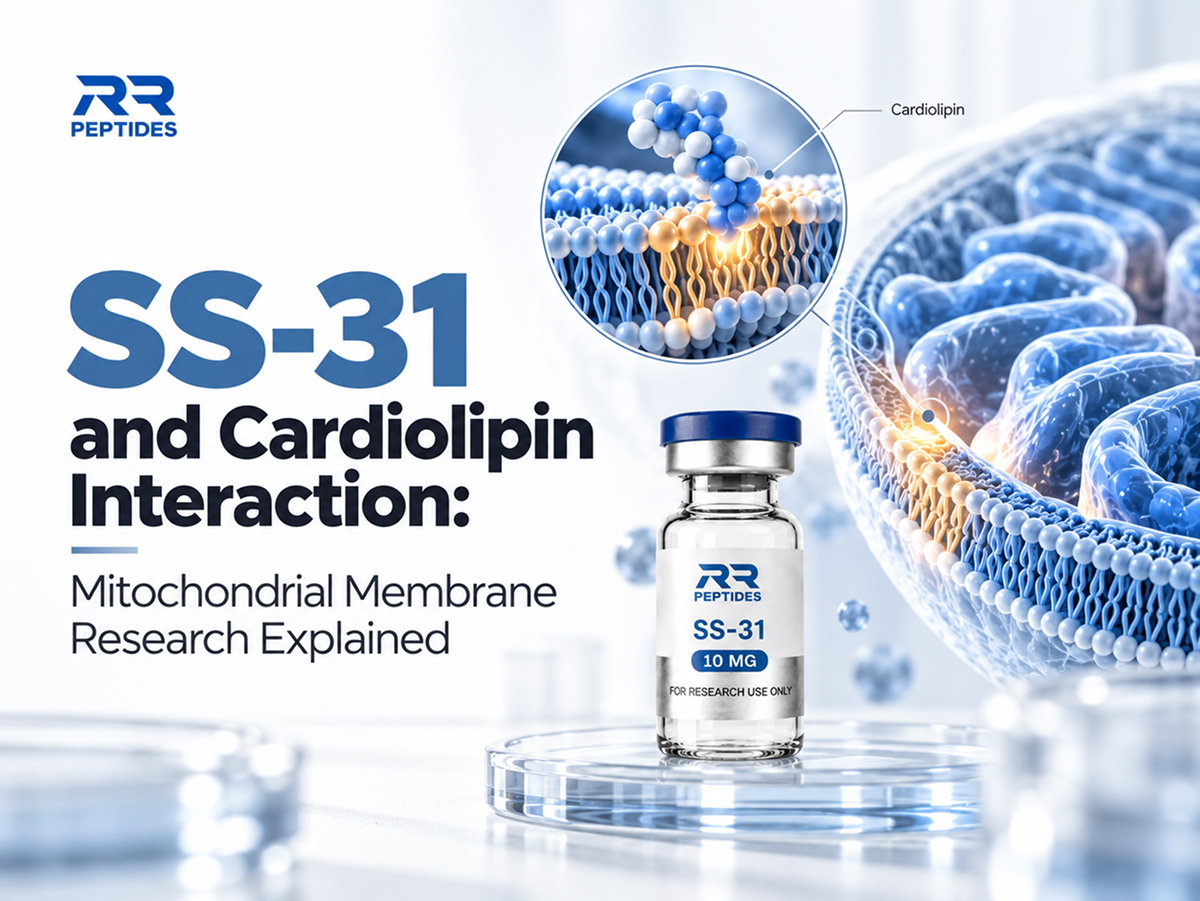
Mitochondria are essential for cellular energy production, metabolic regulation, and responses to physiological stress. However, their ability to perform these functions depends on more than respiratory proteins alone. Specialized membrane lipids also contribute to mitochondrial organization, particularly cardiolipin, a phospholipid concentrated within the inner mitochondrial membrane.
Scientists investigating SS-31 and cardiolipin interaction are interested in how a synthetic tetrapeptide associates with mitochondrial membranes and potentially influences their biological functions. SS-31, also known as elamipretide, has been examined in biochemical experiments, cultured cells, isolated mitochondria, and clinical research.
Although several studies have demonstrated interactions between SS-31 and cardiolipin-containing membranes, important questions remain about their functional consequences. Molecular binding does not automatically establish improved mitochondrial performance or clinical effectiveness.
Understanding SS-31 and cardiolipin interaction therefore requires examining membrane structure, respiratory protein organization, oxidative stress, and the limitations of experimental evidence.
For laboratories exploring mitochondrial biology, RR Peptides provides research materials and product information to support experimental planning. Review available specifications, analytical documentation, and applicable institutional requirements before selecting compounds for laboratory investigations.
What Is Cardiolipin and Why Is It Important in Mitochondria?
Understanding the molecular structure of cardiolipin
Cardiolipin is a specialized phospholipid found predominantly within the inner mitochondrial membrane of eukaryotic cells. Unlike conventional phospholipids containing two fatty acid chains, cardiolipin contains four acyl chains connected through a distinctive molecular structure. This arrangement contributes to its unusual physical properties and interactions with membrane proteins.
Cardiolipin also carries negative charges under relevant biological conditions, making it an important component of the mitochondrial lipid environment. Its molecular composition varies between tissues and organisms, while remodeling processes influence the distribution of individual cardiolipin species.
Research involving SS-31 and cardiolipin interaction considers these characteristics because membrane composition may affect how the peptide associates with mitochondrial lipids.
Cardiolipin and mitochondrial respiratory proteins
The inner mitochondrial membrane contains respiratory complexes responsible for transferring electrons and establishing the electrochemical gradient required for ATP synthesis. Cardiolipin contributes to the structural environment supporting these proteins and their higher-order assemblies.
Its principal research-relevant functions include:
Respiratory organization: Supporting interactions among selected electron transport proteins.
Membrane architecture: Contributing to lipid packing and mitochondrial membrane curvature.
Protein interactions: Influencing the local environment surrounding mitochondrial proteins.
Cellular signaling: Participating in processes associated with mitochondrial stress responses.
These functions help explain why SS-31 and cardiolipin interaction has attracted attention in mitochondrial research. Nevertheless, cardiolipin association alone cannot establish that a peptide directly improves respiratory activity.
Cardiolipin remodeling and oxidative modification
Cardiolipin undergoes biochemical remodeling that influences its fatty acid composition. Additionally, oxidative conditions may alter cardiolipin molecules and their interactions with surrounding proteins.
Researchers studying SS-31 and cardiolipin interaction investigate whether peptide association influences selected membrane-related processes under controlled conditions. However, changes observed in artificial membranes should not automatically be generalized to intact cells.
Cardiolipin property
Biological importance
Research consideration
Four acyl chains
Influences lipid organization
Composition varies by tissue
Negative charge
Supports molecular interactions
Binding depends on conditions
Inner membrane enrichment
Supports respiratory organization
Distribution requires validation
Lipid remodeling
Influences membrane composition
Molecular species differ
Oxidative modification
May affect protein interactions
Requires specific assays
Together, these properties establish cardiolipin as an important component of mitochondrial biology and a relevant subject for mechanistic investigation.
How Is SS-31 Proposed to Interact With Cardiolipin?
Molecular characteristics of SS-31
SS-31 is a synthetic tetrapeptide with the sequence D-Arg-Dmt-Lys-Phe-NH2, where Dmt represents 2,6-dimethyltyrosine. Its molecular structure contains positively charged and aromatic residues that contribute to interactions with biological membranes.
Unlike some mitochondrial-targeting compounds, SS-31 does not depend exclusively on mitochondrial membrane potential for its association with mitochondrial membranes. Instead, its physicochemical characteristics support interactions with negatively charged lipid environments.
The proposed SS-31 and cardiolipin interaction involves molecular relationships between the peptide and cardiolipin-containing membranes. However, electrostatic attraction alone does not completely explain binding behavior, and additional molecular forces may contribute.
Evidence from biochemical binding experiments
Researchers investigate peptide–lipid relationships using artificial membranes, isolated mitochondrial preparations, and purified biochemical systems. These approaches allow investigators to adjust lipid composition, peptide concentration, and environmental conditions while measuring molecular responses.
Experimental evidence supporting SS-31 and cardiolipin interaction includes observations involving cardiolipin-containing lipid systems. Nevertheless, artificial membranes cannot reproduce every characteristic of living mitochondria, including complex protein organization and metabolic regulation.
Therefore, researchers should combine biochemical findings with cellular measurements before proposing broader functional conclusions.
Cytochrome c and cardiolipin-associated activity
Cytochrome c is a mitochondrial protein responsible for transferring electrons between respiratory complexes III and IV. Under certain conditions, its association with cardiolipin can influence biochemical activity, including reactions associated with lipid oxidation.
Studies examining SS-31 and cardiolipin interaction have investigated whether peptide association modifies cardiolipin-related cytochrome c behavior. Some biochemical findings suggest that SS-31 can influence these interactions under defined experimental conditions. However, results obtained using purified proteins do not automatically establish equivalent effects in intact mitochondria, where numerous additional molecular interactions occur.
Consequently, researchers must distinguish direct biochemical observations from downstream cellular responses.
Understanding different levels of evidence
A molecular interaction can be investigated at several experimental levels. Each provides useful information, but the conclusions supported by these methods differ.
Experimental system
Primary research question
Main limitation
Artificial lipid membrane
Does peptide association occur?
Limited biological complexity
Purified protein system
Are biochemical reactions affected?
Lacks cellular regulation
Isolated mitochondria
Are respiratory processes altered?
Removed from cellular context
Cultured cells
What cellular responses occur?
Exposure conditions may differ
Animal model
Are tissue outcomes associated?
Human translation remains uncertain
For SS-31 and cardiolipin interaction, evidence from several complementary systems provides a stronger mechanistic foundation than any individual experiment.
Explore mitochondrial function and cellular research with RR Peptides’ research compound, SS-31 10mg.
Why Does Cardiolipin Matter for Mitochondrial Membrane Structure?
Inner mitochondrial membrane architecture
The inner mitochondrial membrane contains specialized folds called cristae. These structures increase membrane surface area and help organize proteins responsible for oxidative phosphorylation. Their architecture depends on interactions among lipids, respiratory complexes, and proteins involved in membrane organization.
Cardiolipin contributes to these relationships through its molecular structure and physical properties. Changes in cardiolipin composition may influence membrane organization under certain experimental conditions.
Research examining SS-31 and cardiolipin interaction considers whether peptide association affects selected structural properties of mitochondrial membranes. However, observing changes in membrane morphology does not independently establish improved mitochondrial function.
Cardiolipin and membrane curvature
Membrane curvature influences mitochondrial organization and the distribution of proteins within cristae. Cardiolipin possesses physical characteristics that contribute to curved membrane regions and interactions involving structural proteins.
Its four acyl chains and distinctive headgroup influence lipid packing within the membrane. Nevertheless, membrane behavior depends on numerous interacting components rather than cardiolipin alone.
Investigations involving SS-31 and cardiolipin interaction may examine whether peptide association modifies lipid organization or related membrane properties. Such observations require careful interpretation because simplified lipid systems do not fully reproduce mitochondrial architecture.
Respiratory protein organization
Cardiolipin contributes to the structural environment surrounding several respiratory complexes. These proteins participate in electron transport and help generate the electrochemical gradient required for ATP synthesis.
Because membrane composition influences protein organization, researchers investigate whether changes in lipid interactions correspond with measurable respiratory responses.
The relevance of SS-31 and cardiolipin interaction becomes clearer when structural observations are connected with functional measurements. However, improved protein organization cannot be assumed from peptide binding alone.
Methods used to investigate membrane structure
Researchers employ several complementary approaches to examine mitochondrial membrane architecture:
Electron microscopy: Visualizes cristae morphology and mitochondrial ultrastructure.
Lipidomics: Identifies cardiolipin species and changes in lipid composition.
Fluorescence microscopy: Examines mitochondrial organization within cells.
Protein analysis: Investigates respiratory complexes and associated assemblies.
Artificial membrane assays: Evaluates lipid interactions under controlled conditions.
Each method addresses a different biological question. For example, microscopy provides structural information, whereas lipidomics characterizes molecular composition.
Research method
Main measurement
Important limitation
Electron microscopy
Cristae morphology
Preparation may affect appearance
Lipidomics
Cardiolipin composition
Does not establish function
Fluorescence imaging
Mitochondrial distribution
Probe specificity varies
Protein complex analysis
Respiratory organization
Structure differs from activity
Membrane binding assays
Peptide–lipid association
Simplified experimental environment
When studying SS-31 and cardiolipin interaction, combining these approaches helps distinguish structural associations from functional consequences.
How May SS-31–Cardiolipin Interactions Affect Mitochondrial Function?
Electron transport and mitochondrial respiration
The mitochondrial electron transport chain transfers electrons through coordinated protein complexes, generating an electrochemical gradient across the inner mitochondrial membrane. This gradient supports ATP synthesis and other mitochondrial functions.
Cardiolipin contributes to the structural environment surrounding respiratory proteins. Consequently, SS-31 and cardiolipin interaction has been investigated in relation to mitochondrial respiration and electron transport organization.
Some experimental studies report changes in oxygen consumption following SS-31 exposure. However, increased respiration does not necessarily indicate improved mitochondrial efficiency. Researchers must consider substrate availability, ATP demand, membrane integrity, and experimental conditions before interpreting these findings.
ATP production and metabolic regulation
ATP synthesis depends on coordinated electron transport, proton movement, and ATP synthase activity. Changes in mitochondrial membrane organization may influence these processes, particularly under experimentally induced stress.
Research examining SS-31 and cardiolipin interaction includes measurements of ATP concentrations and other energy-related endpoints. Nevertheless, increased cellular ATP availability does not demonstrate direct stimulation of ATP synthase.
ATP concentrations reflect both production and consumption. Therefore, complementary measurements are necessary to distinguish changes in energy generation from altered cellular demand.
Oxidative stress and cardiolipin modification
Mitochondria generate reactive oxygen species during normal metabolism. These molecules participate in signaling but may contribute to oxidative damage when production exceeds cellular regulatory capacity.
Cardiolipin oxidation is relevant because chemical modifications can influence membrane properties and protein interactions.
Some studies investigating SS-31 and cardiolipin interaction examine whether peptide association affects biochemical conditions associated with lipid oxidation. However, reduced oxidative stress markers should not automatically be interpreted as comprehensive antioxidant protection.
Researchers must evaluate assay specificity, experimental controls, and alternative explanations for observed changes.
Cellular signaling and survival
Mitochondria participate in signaling pathways associated with metabolic adaptation and programmed cell death. Under certain conditions, changes in mitochondrial membrane integrity and cytochrome c distribution can influence apoptosis-related processes.
Research involving SS-31 and cardiolipin interaction therefore extends beyond respiratory measurements to selected cellular outcomes. However, altered expression of individual signaling proteins cannot independently establish improved cellular survival.
Functional assays, biological replication, and appropriate comparison groups remain necessary.
Integrating functional measurements
A comprehensive experimental investigation should connect molecular interactions with measurable biological outcomes.
Relevant endpoints include:
Oxygen consumption and respiratory activity.
ATP concentrations and metabolic intermediates.
Mitochondrial membrane potential.
Cardiolipin oxidation and lipid composition.
Cytochrome c-associated biochemical activity.
Cellular viability and stress responses.
Functional endpoint
Research purpose
Scientific limitation
Oxygen consumption
Evaluate respiration
Does not prove efficiency
ATP concentration
Assess energy balance
Reflects production and consumption
Membrane potential
Examine electrochemical conditions
Higher values are not always beneficial
Lipid oxidation
Investigate oxidative modification
Assay validation is essential
Cellular viability
Evaluate survival
Does not identify direct targets
Together, these measurements can strengthen interpretation of SS-31 and cardiolipin interaction, although agreement between endpoints does not independently establish causation.
Explore mitochondrial function and cellular research with RR Peptides’ research compound, SS-31 10mg.
How Do Researchers Study SS-31 and Cardiolipin Interactions?
Artificial membrane and biochemical investigations
Artificial lipid membranes provide controlled environments for studying molecular interactions. Researchers can modify cardiolipin concentration, lipid composition, temperature, and peptide exposure to examine changes in binding behavior.
These systems are useful for investigating SS-31 and cardiolipin interaction because they isolate selected molecular relationships from broader cellular complexity.
However, simplified membranes lack the complete protein environment and metabolic regulation found in intact mitochondria. Consequently, biochemical findings require confirmation through complementary experimental models.
Isolated mitochondria and cultured cells
Isolated mitochondria allow researchers to investigate respiration, membrane potential, and selected biochemical processes under controlled conditions. Cultured cells provide additional information about how mitochondrial responses interact with broader cellular metabolism.
When examining SS-31 and cardiolipin interaction, investigators may compare findings across these systems to determine whether observed effects remain consistent.
Nevertheless, peptide uptake, exposure duration, nutrient conditions, and baseline mitochondrial activity can influence results. Researchers should document these variables and avoid assuming that responses observed in one cell line will reproduce across different tissues.
Animal models and clinical research
Preclinical animal studies connect molecular measurements with tissue-level outcomes. These investigations can provide valuable information about mitochondrial biology under experimentally defined conditions.
However, species differences, intervention methods, and physiological complexity limit direct translation to humans.
SS-31, also known as elamipretide, has also progressed into human clinical research, including studies involving mitochondrial disorders. Clinical findings must be interpreted according to their specific populations, endpoints, and regulatory context.
Importantly, clinical observations do not automatically establish every proposed molecular mechanism underlying SS-31 and cardiolipin interaction.
Canadian laboratory considerations
Canadian institutions investigating mitochondrial biology should distinguish laboratory research materials from products authorized for clinical use.
Health Canada requirements depend on product classification, intended application, and research activities. Commercial availability alone does not establish authorization for human administration.
For SS-31 and cardiolipin interaction studies, laboratories should prioritize:
Verified peptide identity and analytical documentation.
Defined cardiolipin composition and material sources.
Appropriate experimental concentrations and controls.
Validated assays and biological replication.
Transparent statistical analysis and reporting.
Applicable institutional approvals and safety procedures.
These practices support reproducibility and responsible scientific interpretation.
Questions requiring further investigation
Several mechanistic questions remain unresolved. Researchers continue to investigate whether cardiolipin association explains all reported effects, how membrane composition influences peptide behavior, and which molecular changes directly contribute to functional outcomes.
Further SS-31 and cardiolipin interaction research should compare findings across different biological models while accounting for experimental conditions.
Independent replication, standardized analytical methods, and transparent reporting will help distinguish reproducible mechanisms from model-specific observations.
Cardiolipin is a specialized phospholipid concentrated within the inner mitochondrial membrane. It contributes to membrane organization, respiratory protein interactions, and processes associated with oxidative phosphorylation.
Does SS-31 interact directly with cardiolipin?
Biochemical investigations support associations between SS-31 and cardiolipin-containing membranes. However, SS-31 and cardiolipin interaction must be interpreted according to the experimental conditions used to establish binding.
Can SS-31 improve mitochondrial respiration?
Some preclinical studies report changes in respiratory measurements following SS-31 exposure. Nevertheless, these observations do not independently establish improved mitochondrial function in humans or demonstrate clinical effectiveness.
Does cardiolipin influence ATP synthesis?
Cardiolipin contributes to the structural environment supporting respiratory proteins involved in oxidative phosphorylation. However, ATP production depends on multiple processes, including electron transport, substrate availability, and cellular energy demand.
Is SS-31 a conventional antioxidant?
SS-31 is not adequately characterized simply as a conventional free radical scavenger. Its investigated activity involves mitochondrial membrane interactions that may influence oxidative stress-related processes under selected experimental conditions.
Why is further research necessary?
The relationship between peptide binding, membrane organization, and downstream mitochondrial responses remains incompletely understood. Further SS-31 and cardiolipin interaction studies require validated assays, independent replication, and careful separation of laboratory findings from clinical conclusions.
Conclusion
Cardiolipin contributes to mitochondrial membrane organization, respiratory protein interactions, and processes associated with cellular energy production. Its distinctive molecular structure makes it an important component of mitochondrial biology.
SS-31 has attracted scientific attention because of its association with cardiolipin-containing membranes and its potential influence on selected mitochondrial processes.
Nevertheless, SS-31 and cardiolipin interaction remains an evolving research area. Molecular binding provides an important mechanistic foundation, but individual functional outcomes require independent experimental confirmation.
For Canadian laboratories, reliable analytical methods, appropriate oversight, and transparent reporting remain essential to responsible mitochondrial research.
Explore RR Peptides research materials, product specifications, and educational resources when planning laboratory investigations. Review available documentation and confirm that selected compounds meet your experimental requirements.
Disclaimer: All products and compounds discussed are intended strictly for laboratory and research purposes. This article is provided for educational and informational purposes only. This article is not medical advice, therapeutic guidance, or instructions for human administration.
×
Subscribe & Get 10% Off!
Enter your email address below to subscribe to our newsletter and receive an instant 10% OFF discount coupon code sent directly to your inbox!
Thank you for subscribing! Your 10% discount coupon has been sent to your email. Please check your inbox!