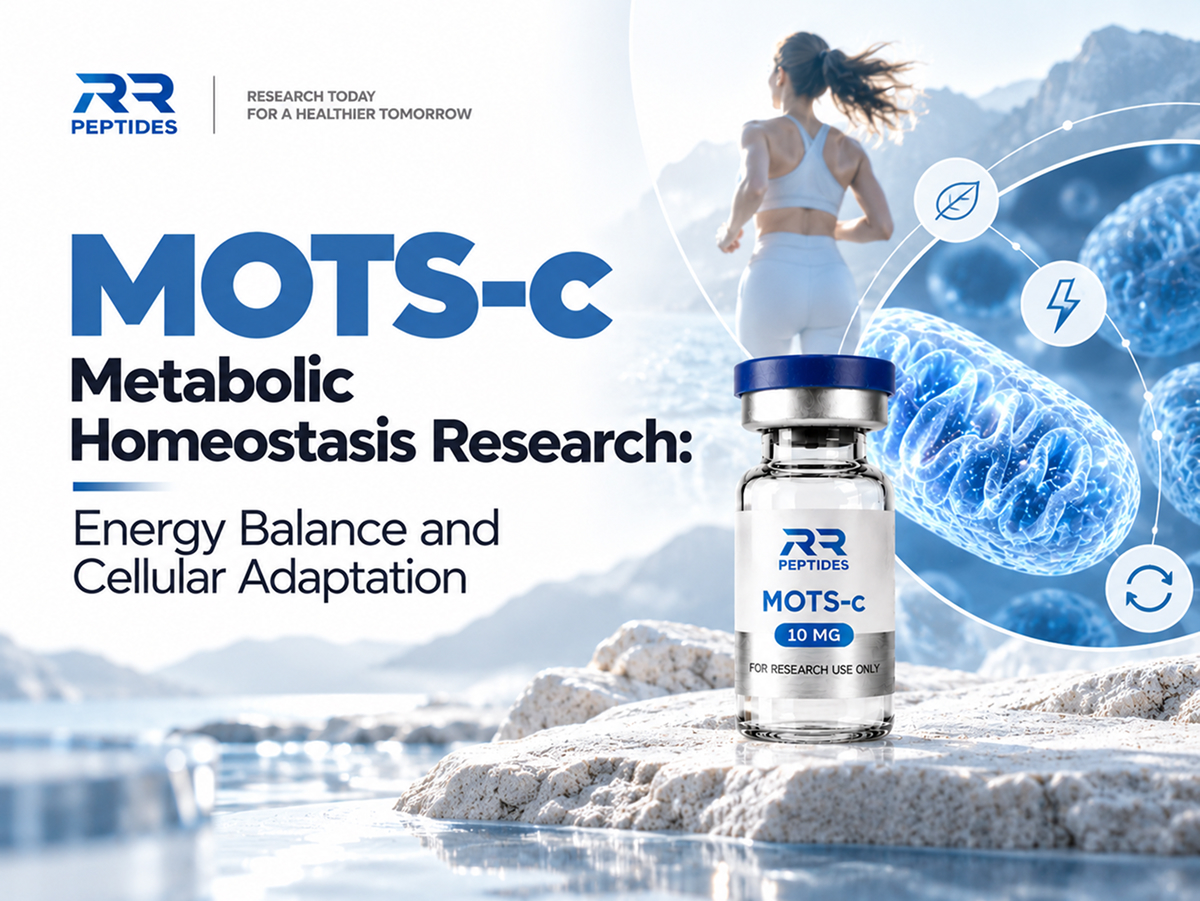
Metabolic homeostasis describes the ongoing coordination of nutrient availability, energy production, and cellular demand. Mitochondria contribute to this balance through respiration, metabolic signaling, and communication with other compartments. Scientists increasingly investigate mitochondrial-derived peptides to understand how cells adjust when conditions change.
MOTS-c metabolic homeostasis research focuses on a sixteen-amino-acid peptide encoded within the mitochondrial 12S ribosomal RNA region. Preclinical findings connect MOTS-c with selected metabolic intermediates, AMPK-associated signaling, and stress-responsive cellular processes. However, these observations do not establish clinical benefits or identical effects across tissues.
For Canadian laboratories investigating mitochondrial peptides, RR Peptides offers research-focused compound information and available product specifications. Researchers should independently assess analytical identity, documentation, and institutional requirements before selecting study materials.
This guide examines the mechanisms, experimental approaches, and unanswered questions shaping MOTS-c metabolic homeostasis research.
What Is Metabolic Homeostasis in Cellular Research?
Metabolic homeostasis is the dynamic regulation of processes that supply, store, and consume energy. It does not mean that every metabolic measurement stays constant. Instead, cells adjust their pathways as nutrients, workloads, and environmental conditions fluctuate.
MOTS-c metabolic homeostasis research explores these adjustments through specific molecular and functional measurements.
Balancing Energy Supply and Demand
ATP supports transport, biosynthesis, and maintenance of ion gradients. Mitochondrial oxidative phosphorylation contributes substantially to ATP generation in many aerobic tissues, although the contribution differs among cell types.
Importantly, ATP concentration reflects both production and consumption. Higher ATP abundance alone cannot prove that mitochondria have become more efficient.
Researchers therefore distinguish energy availability from energy utilization. They may measure oxygen consumption, ATP-associated activity, and metabolite concentrations together.
In MOTS-c metabolic homeostasis research, this combined approach helps separate genuine functional changes from shifts in cellular demand.
Regulatory Networks That Maintain Balance
Several systems participate in metabolic coordination:
AMPK: Responds to cellular energetic conditions and influences selected metabolic pathways.
Insulin-associated signaling: Regulates nutrient handling in relevant tissues.
mTOR-related pathways: Integrate nutrient information with growth-associated processes.
Mitochondrial quality control: Supports organelle maintenance and turnover.
Stress-responsive transcription: Adjusts expression of selected metabolic and protective proteins.
These networks overlap, but their individual activities are not interchangeable.
Consequently, MOTS-c metabolic homeostasis research should define which pathway is being investigated rather than treating general stress markers as evidence of metabolic improvement.
Homeostasis Versus Adaptation
Research concept
Central question
Example measurement
Energy status
Is energy availability changing?
ATP-related assays
Substrate use
Which fuels support metabolism?
Metabolite profiling
Respiration
How does oxygen consumption respond?
Respirometry
Signaling
Which pathways become active?
Protein phosphorylation
Adaptation
Does function persist after challenge?
Time-course assays
A transient signaling response may occur without sustained adaptation. Likewise, recovery following a challenge is not equivalent to improved baseline function.
MOTS-c metabolic homeostasis research becomes more informative when investigators distinguish these outcomes before collecting data.
Discover a high-purity synthetic peptide designed for advanced laboratory studies with RR Peptides MOTS-c 10mg.
MOTS-c belongs to a group of peptides associated with mitochondrial genetic sequences. Its unusual origin has encouraged investigation of communication between mitochondrial biology and broader cellular regulation.
Nevertheless, peptide origin alone does not establish a specific physiological function.
Foundational Experimental Observations
A foundational 2015 study in Cell Metabolism described MOTS-c and investigated its metabolic effects using cultured cells and mice.
Researchers reported changes involving folate-related metabolism, purine biosynthesis, and AMPK-associated activity. These findings established a mechanistic research direction, not a validated human treatment.
MOTS-c metabolic homeostasis research builds on those observations by examining which biochemical changes precede particular signaling responses.
Metabolic Intermediates and AMPK
One proposed connection involves AICAR, a purine biosynthesis intermediate associated with AMPK regulation.
Early experiments linked MOTS-c exposure to altered metabolic intermediates and AMPK-related signaling. However, an association does not demonstrate that MOTS-c directly binds or activates AMPK in every biological setting.
Researchers must distinguish among several possibilities:
MOTS-c alters upstream metabolic conditions that subsequently influence AMPK.
AMPK contributes to selected downstream effects but does not mediate every response.
Parallel pathways produce some observations independently of AMPK activity.
Each explanation requires different controls.
Therefore, MOTS-c metabolic homeostasis research benefits from combining pathway perturbation, metabolite profiling, and functional measurements. A phosphorylation assay alone cannot identify the complete causal sequence.
Communication With the Nucleus
A 2018 preclinical study reported stress-associated movement of MOTS-c into the nucleus under certain experimental conditions.
Investigators connected this observation with AMPK activity and stress-responsive transcriptional regulation. Such results suggest a possible route for mitochondrial-nuclear communication, although transport mechanisms and downstream causal relationships remain incompletely understood.
MOTS-c metabolic homeostasis research may examine peptide localization alongside transcriptional changes.
Nevertheless, nuclear staining does not establish improved metabolic balance. Imaging controls, antibody specificity, and independent confirmation are important for interpretation.
Observation
Research significance
Unresolved issue
Mitochondrial genetic origin
Potential mitochondrial signaling
Endogenous regulation
Metabolite changes
Association with metabolic pathways
Causal sequence
AMPK-associated activity
Possible energy-sensing involvement
Direct versus indirect action
Nuclear localization
Stress-associated redistribution
Transport and necessity
Mouse metabolic outcomes
Preclinical physiological associations
Human relevance
Together, these findings make MOTS-c metabolic homeostasis research scientifically interesting while highlighting the need for independent replication.
How May MOTS-c Influence Glucose and Energy Metabolism?
Glucose metabolism includes uptake, intracellular processing, storage, and oxidation. The balance among these processes varies across tissues and environmental conditions. Researchers should therefore avoid presenting glucose handling as a single universal response to MOTS-c.
Glucose Uptake and Utilization
Preclinical MOTS-c studies have examined glucose-related outcomes in experimental metabolic models. However, results from cells or animals do not establish improved glucose regulation in humans.
MOTS-c metabolic homeostasis research can separate uptake from downstream utilization by measuring transport-associated processes alongside glycolytic and respiratory activity.
Useful endpoints include:
Glucose uptake assessed with validated experimental tracers.
Extracellular glucose and lactate concentrations across time.
Expression or localization of relevant glucose transport proteins.
Oxygen consumption and extracellular acidification measurements.
Intracellular metabolites associated with glycolysis and energy balance.
Increased uptake may occur without proportional oxidation. Similarly, reduced lactate release may reflect several different metabolic changes.
MOTS-c metabolic homeostasis research therefore requires complementary assays rather than assuming one measurement describes the entire fate of glucose.
AMPK and Energy Allocation
AMPK helps coordinate energy-consuming and energy-producing processes when cellular conditions change. Its effects depend on tissue identity, substrate availability, and interactions with other regulatory systems.
In MOTS-c metabolic homeostasis research, investigators may assess AMPK phosphorylation, selected downstream targets, and energy-related metabolites.
Importantly, phosphorylation does not independently demonstrate improved mitochondrial efficiency, endurance, or physical performance.
Lipid Metabolism and Substrate Flexibility
Cells can alter their reliance on carbohydrates and lipids according to nutrient conditions. However, changes in substrate preference must be measured rather than inferred from pathway expression alone.
MOTS-c metabolic homeostasis research may examine lipid-associated metabolites and substrate-dependent respiration in controlled models. Any claim that the peptide directly increases fat oxidation requires specific functional evidence.
Mitochondrial Respiration Under Challenge
Respiratory measurements can help determine whether a defined intervention changes cellular oxygen consumption.
Yet oxygen consumption depends on cell number, viability, substrate supply, and preparation methods. Researchers should distinguish basal respiration from ATP-linked and challenge-responsive measurements.
Endpoint
What it describes
Common limitation
Glucose uptake
Entry of glucose into cells
Uptake is not oxidation
Lactate release
Aspect of glycolytic metabolism
Not a specific injury marker
AMPK phosphorylation
Signaling state
Not proof of benefit
Oxygen consumption
Respiratory activity
Requires normalization
ATP abundance
Net energy-related state
Depends on consumption
Lipid metabolites
Selected substrate pathways
Limited whole-body inference
MOTS-c metabolic homeostasis research should interpret these measurements together.
For example, higher respiratory activity could reflect greater substrate availability rather than an intrinsic increase in mitochondrial capacity. Matching culture conditions and measuring viability help clarify alternative explanations.
Tissue-Specific Responses
Skeletal muscle, liver, adipose tissue, and immune cells perform different metabolic functions. Consequently, a finding in one immortalized cell line may not generalize to primary tissue or an intact organism.
Investigators should report cell identity, metabolic phenotype, and experimental context whenever comparing outcomes across models.
Another consideration involves differences between resting and metabolically challenged cells. A response observed during nutrient limitation may disappear when substrate availability returns to baseline.
Similarly, changes detected immediately after an experimental intervention may not persist during longer observation periods. Researchers should therefore distinguish temporary biochemical adjustments from sustained metabolic adaptation.
Comparing baseline and challenged conditions can reveal whether a particular response depends on the surrounding metabolic environment. This approach also helps identify experimental findings that warrant further investigation across independent biological systems and study conditions.
How Is Metabolic Adaptation Evaluated in MOTS-c Research?
A credible study defines the metabolic challenge, establishes baseline measurements, and evaluates responses over an appropriate period. Researchers should distinguish immediate pathway activation from sustained functional adaptation.
Cultured Cell Models
Cell culture allows controlled comparisons of nutrient conditions and selected signaling responses. Investigators may examine AMPK activity, metabolic intermediates, transcriptional changes, and respiration.
Researchers should document cell authentication, passage history, culture composition, and biological replication. Otherwise, differences in glucose concentration, serum, or cell density can obscure interpretation.
MOTS-c metabolic homeostasis research requires consistent experimental conditions to establish whether observed differences reflect peptide-associated responses.
Animal Models
Animal studies can capture interactions among tissues that isolated cells cannot reproduce. Early MOTS-c experiments included mouse metabolic models. However, species differences, experimental conditions, and tissue distribution limit translation.
MOTS-c metabolic homeostasis research should clearly identify animal findings as preclinical and avoid presenting them as evidence of human efficacy or safety. Appropriate independent ethics review and animal welfare procedures are essential.
Selecting Meaningful Biomarkers
A useful experimental design combines biochemical indicators with functional measurements.
For instance, researchers might examine AMPK signaling alongside oxygen consumption and selected metabolites. Such combinations help distinguish transient signaling from altered cellular performance.
Study element
Example assessment
Reporting priority
Baseline state
Energy and substrate measures
Initial comparability
Defined challenge
Nutrient or metabolic condition
Reproducible exposure
Signaling
AMPK and downstream targets
Assay validation
Metabolic activity
Respiration and metabolite profiles
Appropriate normalization
Cellular outcome
Viability and recovery
Functional relevance
Replication
Independent experiments
Variability and uncertainty
Controls and Reproducibility
Researchers should include suitable baseline and vehicle controls, verify peptide identity, and distinguish technical repeats from independent biological replicates. They should also document missing observations, report effect sizes, and explain uncertainty.
Careful interpretation also depends on transparent reporting of experimental limitations. MOTS-c metabolic homeostasis research requires these safeguards because technical variation can resemble biological adaptation.
Canadian Laboratory Considerations
Canadian researchers must distinguish laboratory compounds from Health Canada-authorized medicines.
MOTS-c is not an established Health Canada-authorized therapeutic treatment. Research-only material should not be represented as suitable for human administration.
MOTS-c metabolic homeostasis research conducted in Canada should follow applicable institutional ethics, laboratory safety, procurement, and regulatory requirements.
RR Peptides can provide research-focused product information, while laboratories remain responsible for independent suitability assessments.
Discover a high-purity synthetic peptide designed for advanced laboratory studies with RR Peptides MOTS-c 10mg.
What Questions Remain About MOTS-c and Metabolic Regulation?
Important uncertainties concern endogenous peptide regulation, mechanism specificity, tissue differences, and the relationship between molecular observations and physiological outcomes.
Addressing these questions will require independent replication and carefully defined experiments.
Endogenous Production and Measurement
Researchers need clearer information about when endogenous MOTS-c abundance changes and how those changes relate to cellular conditions.
Measuring short peptides in complex biological samples requires validated analytical specificity. Researchers should distinguish endogenous measurements from experiments involving externally supplied synthetic material.
Analytical validation is particularly important when studying small peptides within complex biological samples. Researchers must consider whether detection methods can distinguish the intended molecule from related sequences, degradation products, or background signals.
Sample collection and storage conditions may also influence measured concentrations. Consequently, independent analytical confirmation can strengthen confidence in reported findings. Future studies would benefit from clearly documented detection limits, recovery assessments, and reproducibility testing.
Such information would help laboratories compare observations more reliably and determine whether apparent differences reflect biology or measurement variability.
Direct Targets and Causal Pathways
AMPK-associated effects are frequently discussed, but direct molecular targets and causal sequences remain incompletely established.
Investigators should test whether candidate pathways are necessary for specific outcomes and whether alternative explanations remain plausible.
MOTS-c metabolic homeostasis research can advance through genetic perturbations, independent biochemical assays, and carefully interpreted rescue experiments.
Human Translation and Regulatory Limits
Preclinical observations do not establish a treatment for diabetes, obesity, or any other medical condition. Human safety, pharmacokinetics, and therapeutic efficacy require separate evidence.
For MOTS-c metabolic homeostasis research, this distinction matters when interpreting commercially circulated claims. Scientific interest is not equivalent to regulatory authorization.
Priorities for Future Studies
Future investigations would benefit from several coordinated priorities:
Replicate key observations across independent laboratories.
Improve measurement of endogenous MOTS-c in relevant tissues.
Clarify direct and indirect relationships with AMPK.
Compare responses across physiologically meaningful cell models.
Connect molecular changes with validated functional outcomes.
Publish negative findings and methodological limitations.
These priorities can strengthen MOTS-c metabolic homeostasis research without assuming that every signaling change produces a beneficial physiological effect.
What is the main purpose of studying MOTS-c in metabolic homeostasis?
Researchers investigate whether this mitochondrial-derived peptide participates in energy sensing, metabolic communication, and cellular adaptation.
MOTS-c metabolic homeostasis research evaluates mechanisms rather than presuming clinical benefits.
Does MOTS-c directly activate AMPK?
Early experiments associated MOTS-c with metabolic intermediates and AMPK-related signaling.
However, those observations do not establish universal direct binding or activation. Targeted experiments are necessary to evaluate mechanism dependence.
Can MOTS-c change glucose metabolism?
Preclinical models have reported glucose-related metabolic observations.
Nevertheless, results vary with experimental context, and animal or cellular findings cannot establish improved human glucose control.
Which biomarkers are most useful?
Investigators may combine glucose uptake, metabolic profiling, AMPK-associated signaling, respiration, and cellular viability.
MOTS-c metabolic homeostasis research benefits from independent assays addressing the same hypothesis.
Does nuclear localization demonstrate metabolic improvement?
No. Stress-associated nuclear localization is a mechanistic observation. Researchers must separately establish whether localization is necessary for specific transcriptional or functional outcomes.
Are mouse findings directly applicable to Canadians?
Animal findings can motivate further investigation but do not demonstrate equivalent responses in humans. Canadian clinical claims require appropriate human evidence and regulatory evaluation.
Is MOTS-c approved as a treatment in Canada?
MOTS-c is not an established Health Canada-authorized treatment. Laboratory research compounds should not be represented as approved medicines or products intended for human administration.
What remains uncertain about MOTS-c?
Important uncertainties include endogenous regulation, tissue-specific mechanisms, direct molecular targets, and human relevance.
MOTS-c metabolic homeostasis research must address these gaps before broad physiological conclusions are justified.
Conclusion
Metabolic homeostasis depends on coordinated energy production, substrate handling, signaling, and adaptation. MOTS-c offers an intriguing preclinical subject for investigating relationships between mitochondrial genetic information and cellular metabolic networks.
MOTS-c metabolic homeostasis research has produced observations involving metabolic intermediates, AMPK-associated signaling, and stress-related nuclear localization. However, these findings do not establish clinical effectiveness or universal improvements in energy balance.
Canadian laboratories exploring MOTS-c metabolic homeostasis research can review research-focused material information through RR Peptides while independently assessing analytical records and institutional requirements. Responsible studies should emphasize reproducible methods, appropriate controls, and functional outcomes rather than promotional assumptions.
Ultimately, MOTS-c metabolic homeostasis research will advance through experiments that distinguish pathway associations from causal mechanisms and preclinical observations from human evidence.
Disclaimer: All products and compounds discussed are intended strictly for laboratory and research purposes. This article is provided for educational and informational purposes only. This article is not medical advice, therapeutic guidance, or instructions for human administration.
×
Subscribe & Get 10% Off!
Enter your email address below to subscribe to our newsletter and receive an instant 10% OFF discount coupon code sent directly to your inbox!
Thank you for subscribing! Your 10% discount coupon has been sent to your email. Please check your inbox!