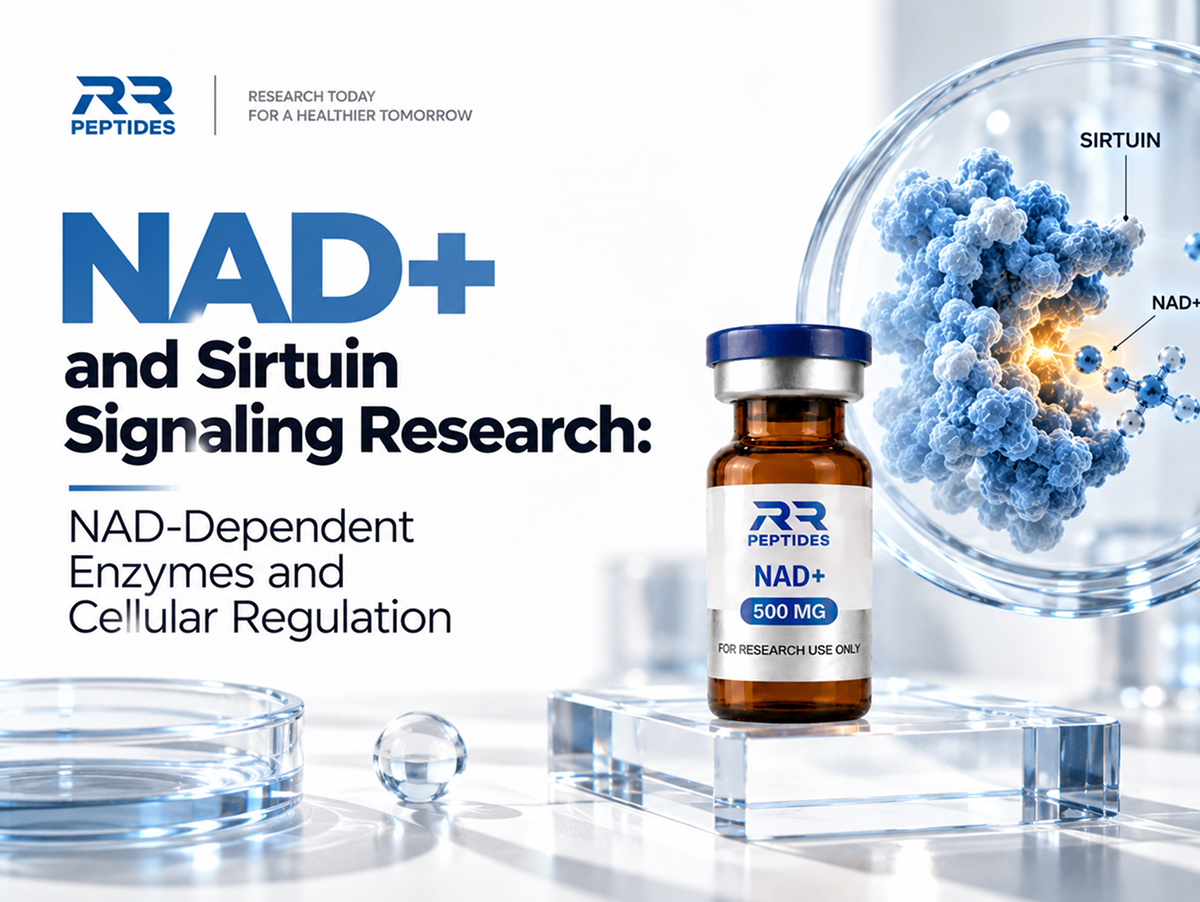
NAD+ and sirtuin signaling research examines how nicotinamide adenine dinucleotide (NAD+) supports enzymes involved in protein modification, gene regulation, metabolism, and cellular responses. NAD+ exists in oxidized and reduced forms, but sirtuins use NAD+ as a required substrate during specific catalytic reactions. Understanding this relationship helps researchers investigate how metabolic conditions intersect with cellular regulation without assuming that one measurement explains the entire system.
In NAD+ and sirtuin signaling research, RR Peptides provides research-focused product information for laboratory audiences. Reviewing product specifications alongside relevant scientific literature can help researchers evaluate materials for a defined experimental question. This article introduces the mechanisms, commonly studied pathways, and analytical considerations behind NAD+ and sirtuin signaling research. It is intended for scientific education and does not present laboratory findings as evidence of clinical benefit.
What Is the Relationship Between NAD+ and Sirtuins?
NAD+ as a cellular coenzyme
In NAD+ and sirtuin signaling research, NAD+ is a coenzyme involved in many cellular reactions, especially those that transfer electrons during metabolism. Its reduced form, NADH, carries reducing equivalents to other biochemical systems. Sirtuins have a distinct relationship with NAD+: they consume it during catalytic reactions rather than using it only as an electron carrier. This distinction is central to NAD+ and sirtuin signaling research.
In NAD+ and sirtuin signaling research, sirtuins are a family of NAD+-dependent enzymes. They differ in cellular location, substrate preference, and biological context. Several remove acyl groups from lysine residues on proteins, including acetyl groups.
What sirtuins do
In NAD+ and sirtuin signaling research, sirtuin activity can affect transcription factors, histones, metabolic enzymes, and other proteins. Removing an acetyl group may change how a protein interacts with DNA or other molecules, or how it participates in a biochemical pathway. The outcome is substrate-specific, so a detected change in sirtuin activity should not automatically be interpreted as a universal improvement in cell function.
NAD+ as substrate and metabolic signal
In NAD+ and sirtuin signaling research, cellular NAD+ availability reflects synthesis, recycling, consumption, and compartment-specific regulation. Since sirtuins require NAD+ for catalytic activity, local availability may influence their reactions. However, a relationship between total cellular NAD+ and a sirtuin-associated outcome does not establish direct causation. Other NAD+-consuming enzymes, altered gene expression, substrate abundance, and cellular stress can affect the same measurements.
In NAD+ and sirtuin signaling research, a useful study begins with a precise question: does a condition change the NAD+ pool, the activity of a particular sirtuin, modification of a target protein, or a downstream cellular response? These are separate outcomes and require different evidence. Measuring sirtuin expression alone does not prove increased catalytic activity, while a change in protein modification does not independently identify which enzyme caused it.
Sirtuin family overview
Sirtuin
Commonly described location
Research themes
SIRT1
Nucleus and cytoplasm
Transcriptional regulation and protein deacetylation
SIRT2
Mainly cytoplasm
Cytoskeletal proteins and cell-cycle-associated processes
SIRT3
Mitochondria
Mitochondrial protein deacetylation and metabolic enzymes
SIRT4
Mitochondria
Metabolic regulation and selected enzyme-related reactions
SIRT5
Mainly mitochondria
Desuccinylation and other lysine deacylation reactions
SIRT6
Nucleus
Chromatin regulation and DNA-associated processes
SIRT7
Nucleolus and nucleus
Ribosomal gene regulation and nucleolar functions
Explore our research-focused product information and specifications for your laboratory studies with NAD+ 500mg.
Why Do Sirtuins Require NAD+ for Enzymatic Activity?
NAD+ participates directly in catalysis
In NAD+ and sirtuin signaling research, sirtuins require NAD+ because it participates directly in the chemical reaction that removes an acyl group from a target protein. During a typical deacetylation reaction, the enzyme binds NAD+ and an acetylated substrate. The reaction produces a deacetylated protein, nicotinamide, and a modified sugar-containing product commonly called O-acetyl-ADP-ribose. The important point is that NAD+ is consumed, rather than acting as a passive cofactor that remains unchanged.
Activity depends on more than NAD+ concentration
In NAD+ and sirtuin signaling research, NAD+ is necessary for sirtuin activity, but it is not the only determinant. Enzyme abundance, substrate availability, post-translational modifications, cellular localization, binding partners, and the chemical environment can influence the measured reaction rate. A cell may contain substantial NAD+ while a particular sirtuin remains limited by substrate access or another regulatory mechanism.
NAD+ and sirtuin signaling research should not treat a rise in total NAD+ as proof that every sirtuin becomes more active. Total cellular measurements combine pools from different compartments and may conceal local differences. Individual sirtuins also have distinct substrate preferences and kinetic characteristics, so a result from one enzyme cannot automatically be generalized to the entire family.
The importance of cellular compartments
In NAD+ and sirtuin signaling research, NAD+ is present in the cytosol, nucleus, and mitochondria, but the pools are not necessarily identical or freely interchangeable. Transport across mitochondrial membranes, local synthesis, and enzymatic consumption can affect availability in each compartment. This matters because many sirtuins are associated with particular cellular locations.
Interpreting NAD+-dependent reactions
In NAD+ and sirtuin signaling research, a robust interpretation distinguishes NAD+ abundance, the NAD+/NADH relationship, sirtuin protein expression, catalytic activity, and changes in target-protein acetylation. These indicators are related but not equivalent. NAD+/NADH provides information about redox-related metabolism, while sirtuin catalysis consumes NAD+ through a different biochemical mechanism. The processes can intersect without being interchangeable.
Which Sirtuin Pathways Are Commonly Studied in NAD+ Research?
SIRT1 and transcriptional regulation
In NAD+ and sirtuin signaling research, SIRT1 is studied because it can modify histones and transcription-related proteins, including selected transcription factors and metabolic regulators. Research often examines how SIRT1-associated deacetylation relates to gene expression, nutrient availability, or cellular stress. These relationships are context-dependent: the same protein modification may have different consequences in different cell types.
In NAD+ and sirtuin signaling research, a study may measure SIRT1 abundance, enzymatic activity, or acetylation of a proposed target. Each endpoint answers a different question. Measuring SIRT1 expression alone does not establish that catalytic activity increased, and observing a target-protein change does not prove that SIRT1 caused it. Appropriate controls and evidence of target engagement are important.
SIRT3 and mitochondrial protein regulation
In NAD+ and sirtuin signaling research, SIRT3 is frequently investigated in mitochondrial research because it can deacetylate proteins involved in energy metabolism and other mitochondrial processes. Investigators may study whether changes in NAD+ availability coincide with altered acetylation of mitochondrial proteins, enzyme activity, or respiratory measurements. However, mitochondrial function is influenced by many pathways, so a single endpoint rarely explains the complete mechanism.
NAD+ and sirtuin signaling research in this area may combine mitochondrial NAD+ measurements with protein acetylation, enzyme assays, and oxygen-consumption analysis. A consistent pattern across complementary measurements can support a stronger interpretation than an isolated change. Conclusions should nevertheless remain specific to the experimental model and its limitations.
SIRT2, SIRT4, and SIRT5
In NAD+ and sirtuin signaling research, SIRT2 is studied in relation to cytoplasmic proteins, microtubule-associated processes, and cell-cycle regulation. SIRT4 has been investigated for roles in mitochondrial metabolic regulation, while SIRT5 is associated with removing several negatively charged acyl modifications from proteins, including succinyl and malonyl groups in suitable contexts. These examples show that sirtuin biology extends beyond one deacetylation pathway.
SIRT6 and SIRT7 in nuclear regulation
In NAD+ and sirtuin signaling research, SIRT6 has been studied in chromatin-associated processes, transcriptional regulation, and DNA-related responses. SIRT7 is often associated with the nucleolus and regulation of ribosomal RNA-related processes. Both have functions that depend on cellular context and substrate. A broad label such as cellular regulation should not replace a clearly defined mechanistic hypothesis.
In NAD+ and sirtuin signaling research, studies may assess histone modifications, transcriptional readouts, enzyme activity, or changes in selected target proteins. Since multiple enzymes can influence chromatin and gene expression, experiments need controls that help distinguish direct sirtuin effects from indirect responses. Independent replication and transparent reporting are important when interpreting pathway-level claims.
Common pathway themes
Research pathway
Example question
Possible measurements
SIRT1-related regulation
Does a condition alter target-protein acetylation?
Protein markers, ribosomal RNA-related measurements
How Can NAD+ Availability Influence Sirtuin Signaling?
Synthesis, recycling, and consumption
In NAD+ and sirtuin signaling research, cells maintain NAD+ through several routes, including synthesis from precursors and recycling through salvage pathways. NAD+ is also consumed by enzymes involved in protein modification and cellular responses to damage. The relative contribution of each route depends on cell type, physiological state, and experimental conditions.
Availability is not a standalone activity marker
In NAD+ and sirtuin signaling research, the requirement for NAD+ creates a mechanistic link with sirtuins, but measured availability alone does not predict the exact magnitude of enzyme activity in a complex biological system. Enzyme kinetics, substrate concentration, product inhibition, cellular localization, and competing reactions can affect outcomes. The relationship may also differ between purified enzyme assays and intact-cell experiments.
In NAD+ and sirtuin signaling research, a careful approach measures the variable directly connected to the hypothesis. If the question is whether a sirtuin is more active, an activity assay or evidence of substrate modification may be more informative than total NAD+ alone. If the question concerns the NAD+ pool, the method should distinguish NAD+ from NADH and describe the sampling procedure.
Experimental factors that influence results
Several variables may affect measurements related to NAD+ and sirtuin signaling:
Cell type, passage number, growth conditions, and confluence.
Nutrient composition, oxygen availability, and incubation duration.
Sample collection, quenching, extraction, and storage.
Specificity and sensitivity of the analytical method.
Abundance of the sirtuin, its substrate, and relevant binding partners.
Appropriate controls, biological replicates, and predefined endpoints.
In NAD+ and sirtuin signaling research, recording these variables supports reproducibility and makes results easier to compare across experiments. A finding from one cell line should not automatically be assumed to apply to another model without additional evidence.
What can and cannot be concluded
NAD+ and sirtuin signaling research is strongest when conclusions match the evidence. Correlation, biochemical plausibility, direct enzyme activity, and causal evidence represent different levels of support. Clear reporting of limitations helps readers assess how far a result can be generalized.
Explore our research-focused product information and specifications for your laboratory studies with NAD+ 500mg.
How Is NAD+-Sirtuin Activity Measured in Research Models?
Measuring NAD+ and NADH
In NAD+ and sirtuin signaling research, researchers can quantify NAD+ and NADH using enzymatic cycling assays, chromatography-based methods, or mass spectrometry. The best choice depends on sample type, expected concentration, sensitivity requirements, available instrumentation, and whether the method can distinguish the oxidized and reduced forms. A validated method should be selected before the experiment begins.
Measuring sirtuin activity and target modification
In NAD+ and sirtuin signaling research, sirtuin activity can be assessed with biochemical assays that use a defined substrate, but artificial substrates may not fully reproduce native protein behavior in cells. Fluorescence-based assays, for example, may require additional validation to confirm that the signal reflects the intended reaction. Negative controls and checks for interference help establish reliability.
Combining complementary endpoints
A well-designed experiment can combine metabolite measurements with direct or indirect measures of sirtuin activity. For mitochondrial questions, researchers may add oxygen-consumption measurements, enzyme activity, or membrane-potential assays. For nuclear pathways, selected histone modifications and gene-expression readouts may be more relevant. The combination should follow the hypothesis rather than attempt to measure every possible endpoint.
Method
What it can indicate
Key limitation
NAD+ / NADH quantification
Abundance of measured coenzyme forms
Does not directly prove sirtuin activity
Sirtuin activity assay
Catalytic activity under defined conditions
Artificial substrates may not reflect intact-cell biology
Protein acylation analysis
Modification state of selected proteins
Other enzymes may influence the same modification
Mass spectrometry
Identification or quantification of metabolites and modifications
Requires suitable preparation and analytical expertise
Gene-expression analysis
Changes in transcript abundance
Transcript levels do not establish enzyme activity
Respiration analysis
Oxygen consumption under defined conditions
Does not isolate sirtuin effects by itself
Quality control and reporting
Useful reporting practices include defining primary endpoints in advance, documenting the cell model and treatment conditions, describing assay validation, and reporting biological replicates and variability. Studies should include controls that test background signal, sample integrity, and potential assay interference. When a result is unexpected, technical explanations should be considered alongside biological explanations.
Canadian research context
Laboratories in Canada should follow applicable institutional safety procedures and current requirements relevant to their materials, facilities, and study design. Regulatory obligations depend on the product, intended use, and research activity; a research-use description should not be interpreted as authorization for human administration. Researchers are responsible for confirming the requirements that apply to their work.
Before selecting research materials, investigators should review available product identity information, specifications, storage guidance, and analytical documentation. RR Peptides provides research-focused product information for laboratory audiences. Such information can support preliminary evaluation, but it does not replace independent verification, institutional review, or a validated experimental protocol.
What is the main connection between NAD+ and sirtuins?
Sirtuins require NAD+ as a substrate for catalytic reactions, including deacetylation and other deacylation processes. NAD+ is consumed during these reactions, so its availability is mechanistically relevant. However, total NAD+ concentration alone does not establish the activity of a particular sirtuin.
Are all sirtuins located in the same part of the cell?
No. Sirtuins differ in their typical localization and function. Some are mainly nuclear or cytoplasmic, while SIRT3, SIRT4, and SIRT5 are strongly associated with mitochondria.
Does a higher NAD+ level always mean higher sirtuin activity?
No. NAD+ is required, but activity also depends on enzyme abundance, substrate availability, localization, product inhibition, and other factors. Researchers should measure sirtuin activity or relevant substrate modifications when those are the primary outcomes.
Which measurements are useful in sirtuin studies?
Depending on the question, useful measures may include NAD+ and NADH quantification, sirtuin activity assays, target-protein acetylation, mass spectrometry, gene-expression analysis, and selected mitochondrial endpoints. The most suitable combination depends on the pathway and experimental model.
Do laboratory findings prove a health benefit in humans?
No. Biochemical assays and preclinical models can clarify mechanisms, but they do not independently demonstrate clinical efficacy or safety. Human health claims require appropriate clinical evidence and a separate assessment of benefits and risks.
Conclusion
NAD+ and sirtuin signaling research explores how a required metabolic coenzyme participates in enzyme-catalyzed protein modification and cellular regulation. Sirtuins differ in location, substrate preference, and biological context, making it important to study individual enzymes rather than treating the family as one pathway. NAD+ availability is relevant to catalysis, but it is only one factor among several that shape measured activity.
Reliable studies combine well-defined hypotheses with appropriate metabolite measurements, enzyme assays, substrate-modification analysis, and controls. They distinguish correlation from causation and avoid extending findings beyond the model used. For laboratory audiences, RR Peptides offers research-focused product information and documentation that can be reviewed alongside scientific literature and experimental requirements.
Disclaimer: All products and compounds discussed are intended strictly for laboratory and research purposes. This article is provided for educational and informational purposes only. This article is not medical advice, therapeutic guidance, or instructions for human administration.
3 Comments
The relationship between NAD and sirtuin signaling is an interesting area of cellular research. This article helps connect NAD availability with the activity of sirtuins and explains why researchers continue to investigate these pathways in cellular regulation.
I appreciate how this topic highlights the connection between cellular metabolism and sirtuin activity. Understanding the role of NAD as a cofactor provides useful context for exploring these signaling pathways, while further research is still needed to clarify their broader biological implications.
This is a useful introduction to NAD-dependent sirtuin signaling. I’d be interested in learning more about how researchers measure these interactions and distinguish established findings from hypotheses that are still being investigated
Comments are closed.
×
Subscribe & Get 10% Off!
Enter your email address below to subscribe to our newsletter and receive an instant 10% OFF discount coupon code sent directly to your inbox!
Thank you for subscribing! Your 10% discount coupon has been sent to your email. Please check your inbox!




The relationship between NAD and sirtuin signaling is an interesting area of cellular research. This article helps connect NAD availability with the activity of sirtuins and explains why researchers continue to investigate these pathways in cellular regulation.
I appreciate how this topic highlights the connection between cellular metabolism and sirtuin activity. Understanding the role of NAD as a cofactor provides useful context for exploring these signaling pathways, while further research is still needed to clarify their broader biological implications.
This is a useful introduction to NAD-dependent sirtuin signaling. I’d be interested in learning more about how researchers measure these interactions and distinguish established findings from hypotheses that are still being investigated