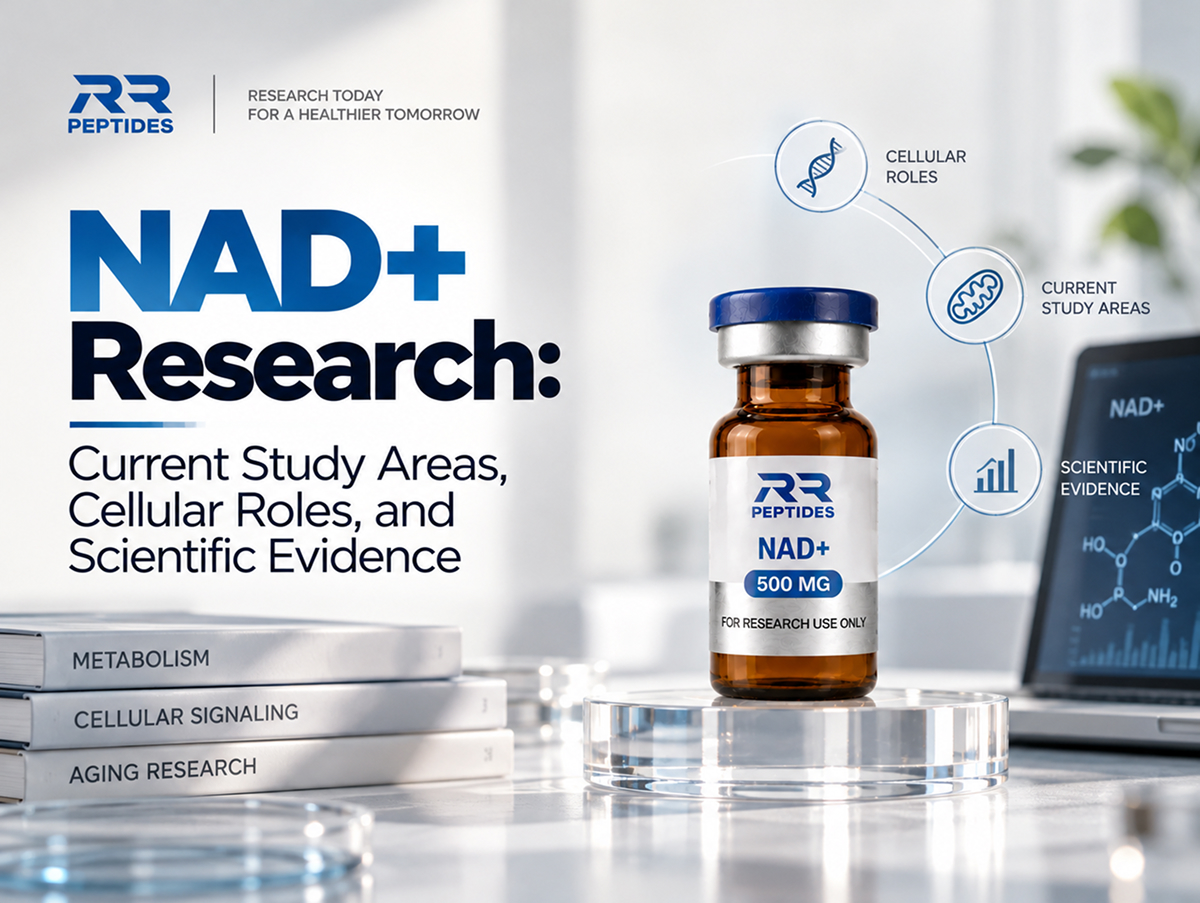
Nicotinamide adenine dinucleotide, commonly known as NAD+, is a coenzyme involved in cellular energy metabolism, oxidation-reduction reactions, and biological signaling. Scientists study it to understand how cells process nutrients, respond to stress, and maintain essential functions. Although its biochemical importance is well established, the implications of changing NAD+ levels remain an active area of investigation.
NAD+ research must separate established mechanisms from emerging hypotheses. Findings from cells or animals do not automatically establish benefits in humans; study design, analytical methods, and biological context shape interpretation.
RR Peptides provides research-focused product information for laboratory audiences. Explore available research materials and supporting documentation while assessing whether a particular material is suitable for an approved scientific investigation.
This article reviews NAD+ biology, major study areas, methods, biomarkers, evidence limitations, and the Canadian research context without making unsupported therapeutic claims.
What Is NAD+ and Why Is It Studied in Cellular Research?
The biochemical role of NAD+
NAD+ is a pyridine nucleotide found in living cells. It exists in two principal forms: oxidized NAD+ and reduced NADH. These forms participate in oxidation-reduction reactions, accepting and donating electrons as cells metabolize nutrients. Their activity connects biochemical pathways involved in energy production and cellular maintenance.
NAD+ also serves as a substrate for enzymes involved in cellular signaling. Two important enzyme groups are poly(ADP-ribose) polymerases, known as PARPs, and sirtuins. PARPs participate in processes associated with DNA-damage responses, while sirtuins regulate cellular functions related to metabolism and stress responses.
These roles explain why NAD+ research extends beyond energy metabolism. A concentration change does not automatically demonstrate improved cellular performance.
NAD+ metabolism and cellular compartments
Cells maintain NAD+ through interconnected synthesis and recycling pathways. These pathways involve several precursors, including nicotinamide and nicotinamide riboside. Nicotinamide mononucleotide, or NMN, is another intermediate investigated in NAD+ metabolism.
Pathway contributions vary by tissue and biological conditions. NAD+ also occurs in the cytosol, nucleus, and mitochondria, which have distinct metabolic environments.
A whole-cell measurement may not represent NAD+ availability in a particular compartment, a limitation relevant to studies of mitochondria, DNA repair, and signaling.
It is also important to distinguish NAD+ from NADH and precursor compounds. Although these molecules are metabolically connected, they are not interchangeable. Evidence concerning one compound cannot automatically establish the properties or effects of another.
Why researchers investigate NAD+
Interest in NAD+ research reflects its involvement in fundamental biological processes. In NAD+ research, scientists investigate how NAD+ availability changes under different conditions and whether those changes influence measurable cellular outcomes.
Common research questions include:
How do cells maintain NAD+ through synthesis and recycling?
How does NAD+ availability relate to metabolic activity?
Which enzymes consume NAD+ during cellular processes?
How do experimental conditions influence NAD+-related biomarkers?
Do observed biochemical changes correspond with functional outcomes?
Answering these questions requires suitable controls and validated methods, while distinguishing biochemical changes from biological significance.
Explore our research-focused product information and specifications for your laboratory studies with NAD+ 500mg.
Which Areas of NAD+ Research Are Currently Most Established?
Cellular energy metabolism and redox biology
One of the best-established areas concerns NAD+’s role in cellular metabolism. NAD+ and NADH participate in glycolysis, the tricarboxylic acid cycle, and other pathways involved in processing nutrients. NADH also transfers electrons into the mitochondrial respiratory chain, supporting oxidative phosphorylation.
These biochemical functions are established, but cellular outcomes also depend on substrate availability, enzyme activity, oxygen conditions, and mitochondrial function.
In NAD+ research, investigators may measure metabolite concentrations, redox-related indicators, and functional endpoints to characterize these relationships.
DNA-damage responses and cellular signaling
PARP enzymes use NAD+ during poly(ADP-ribosyl)ation, a process involved in cellular responses to DNA damage and other biological events. Sirtuins also consume NAD+ and participate in regulating proteins associated with metabolism, stress responses, and gene expression.
In NAD+ research, these mechanisms justify studying NAD+-dependent processes, but do not prove that changing NAD+ availability produces a particular benefit.
In NAD+ research, researchers should measure the relevant endpoint directly. Changes in enzyme expression, enzyme activity, and downstream biological responses represent different observations and should not be treated as equivalent.
Mitochondrial function and metabolic stress
Mitochondria depend on interconnected metabolic pathways to support cellular energy production. Researchers investigate NAD+-related metabolism in experimental models involving nutrient limitation, oxidative stress, and changes in mitochondrial activity.
In NAD+ research, these studies characterize cellular responses to metabolic demands, but mitochondrial markers can change through pathways unrelated to NAD+.
Animal studies may provide additional information about whole-organism responses, but species differences and experimental conditions limit direct translation to humans.
Aging-related biology and precursor studies
In NAD+ research, some studies have reported changes in NAD+ metabolism in tissues and experimental models associated with aging.
Evidence varies by species, tissue, intervention, duration, and endpoint. A biomarker change does not necessarily indicate a meaningful functional outcome.
Researchers should distinguish established biochemical mechanisms from broader hypotheses concerning aging, longevity, or disease prevention.
Research area
Established scientific basis
Important limitation
Redox biology
NAD+/NADH participates in electron-transfer reactions
One measurement may not represent the entire cellular redox state
Energy metabolism
NAD-related reactions support metabolic pathways
Effects depend on cell type and conditions
PARP activity
PARPs consume NAD+ during cellular processes
Pathway activity does not prove a beneficial outcome
Sirtuin biology
Sirtuins use NAD+ as a substrate
Effects vary by enzyme and biological context
Mitochondrial research
NAD-related metabolism connects with energy production
Findings may not translate directly to humans
Aging-related studies
NAD+ metabolism is investigated in aging models
Biomarker changes do not establish longer lifespan
Overall, NAD+ research is most informative when it separates established biochemical functions from hypotheses requiring further validation.
How Is NAD+ Studied in Cellular and Preclinical Models?
In vitro studies
In vitro research examines cells, cellular components, or biochemical systems under controlled laboratory conditions. Investigators may use cultured cells to study NAD+ synthesis, consumption, and relationships with metabolic or stress-related pathways.
These models allow control of selected variables, but cell type, passage number, culture conditions, nutrients, and oxygen exposure can affect metabolism.
A well-designed experiment should include:
A clearly defined research question and primary endpoint.
A validated method suitable for the sample type.
Consistent sample collection and processing procedures.
Sufficient biological replication.
Transparent reporting of limitations and unexpected findings.
In NAD+ research, investigators should specify whether they measure NAD+, NADH, a combined pool, or a downstream functional outcome.
Animal and other preclinical models
Animal models provide information about interactions among organs, metabolism, and whole-organism responses that isolated cells cannot fully reproduce. Researchers may investigate tissue-specific metabolism or biological responses under defined experimental conditions.
Preclinical results have limits: physiology, metabolism, lifespan, and experimental conditions differ, so animal findings cannot independently establish human effects.
In NAD+ research, researchers should evaluate whether the model is appropriate for the scientific question and whether independent studies support the findings. Small exploratory studies can generate hypotheses, but stronger conclusions generally require suitable controls, transparent methods, adequate statistical analysis, and replication.
Analytical methods and quality control
NAD+ and NADH can be measured using different analytical techniques, including chromatography-based methods, mass spectrometry, and selected enzymatic assays. Method selection depends on the analyte, sample matrix, sensitivity requirements, and research objective.
In NAD+ research, collection timing, temperature, extraction, and storage can influence concentrations. Laboratories should validate methods and use quality-control samples.
When comparing published studies, researchers should check:
Whether the studies measured the same analyte.
Whether sample preparation methods were comparable.
Whether analytical methods were adequately validated.
Whether results used compatible units and normalization methods.
Whether reported endpoints addressed the same research question.
Differences in methodology may explain some variation between published findings.
Designing interpretable experiments
A useful experiment explains measurement, uncertainty, and alternative explanations. Researchers should distinguish correlation from causation and report inconclusive findings.
For NAD+ research, a change in one biochemical marker should not automatically be interpreted as proof of a broad biological benefit. Combining biochemical measurements with relevant functional endpoints can provide a more complete assessment.
What Biomarkers Are Commonly Evaluated in NAD+ Research?
Biomarkers measure biological processes or responses. Their usefulness depends on analytical validity and the research question; no single marker captures all NAD+ metabolism.
NAD+ and NADH measurements
In NAD+ research, direct measurement of NAD+ and NADH can help characterize the cellular pools of these related molecules. Researchers may also calculate an NAD+/NADH ratio, but its interpretation depends on the assay, sample handling, and biological compartment.
A ratio calculated from an entire tissue sample may not represent conditions within mitochondria or the nucleus. Researchers should report the analyte, sample type, measurement method, normalization approach, and relevant limitations.
NAD+ research may benefit from measuring both forms when scientifically appropriate. Measuring only one may provide an incomplete picture of the metabolic system being investigated.
Related metabolites and pathway indicators
Other measurements may include nicotinamide, NMN, nicotinamide riboside, and metabolites associated with NAD+ synthesis or breakdown.
These measurements characterize selected pathways, but concentration alone cannot reveal activity because production, consumption, transport, and clearance all contribute.
In NAD+ research, researchers may also investigate PARP or sirtuin activity. However, enzyme expression, enzyme activity, and downstream molecular changes are distinct endpoints and should be evaluated separately when relevant.
Functional and contextual biomarkers
Depending on the research model, investigators may evaluate mitochondrial respiration, cellular energy status, oxidative stress, or DNA-damage-related indicators. These measurements contextualize biochemical results but are not specific to NAD+ metabolism.
Biomarker category
Example measurements
Potential interpretation
Key limitation
NAD-related pool
NAD+, NADH, NAD+/NADH ratio
Selected coenzyme pools
Sensitive to sampling and assay methods
Pathway metabolites
Nicotinamide, NMN, nicotinamide riboside
Selected synthesis or breakdown pathways
Concentration does not establish pathway flux
Enzyme-related
PARP or sirtuin activity
Activity of specific NAD+-dependent processes
Expression and activity differ
Mitochondrial
Respiration and energy-related measurements
Selected aspects of mitochondrial function
Influenced by many biological pathways
Cellular stress
Validated oxidative-stress or DNA-damage markers
Response to defined experimental conditions
Requires suitable controls and specificity
Choosing the right measurement
In NAD+ research, biomarker selection should follow the research question rather than the availability of a convenient assay. If the objective concerns NAD+ metabolism, direct metabolite measurements may be appropriate. If the question concerns functional consequences, biochemical measurements should be paired with relevant functional endpoints.
Researchers should document:
The exact analyte or process measured.
The sample type and collection conditions.
The assay method and validation status.
The units, normalization method, and detection limits.
The primary endpoint and known limitations.
Whether functional measurements support biochemical findings.
These details support transparency and reproducibility.
Explore our research-focused product information and specifications for your laboratory studies with NAD+ 500mg.
What Are the Main Limitations of Current NAD+ Research?
Differences between models and human outcomes
A major limitation is the gap between mechanistic findings and clinical outcomes. Cell and animal models do not prove that findings apply to humans.
Human studies introduce variables such as age, diet, health status, medication use, and baseline metabolism. Short-term biomarker changes may not predict long-term outcomes.
Consequently, claims about prevention, treatment, or longevity require appropriately designed human evidence rather than extrapolation from laboratory findings.
Measurement and study-design challenges
Measurements depend on collection, processing, storage, extraction, and analytical technique. Different tissues, cell lines, normalization methods, and endpoints complicate comparisons.
Sample size, statistical power, endpoint selection, and reporting affect confidence. Exploratory conclusions should remain proportional to the evidence.
When evaluating NAD+ research, readers should consider whether findings have been replicated, whether alternative explanations were addressed, and whether the authors clearly acknowledged limitations.
Association does not establish causation
An association between NAD+ levels and an outcome does not establish causation; other processes may influence both, or the measured change may be a consequence.
In NAD+ research, researchers should use appropriate controls and experimental designs capable of testing the proposed mechanism. Conclusions should not extend beyond the measurements and conditions actually investigated.
Regulatory and evidence considerations in Canada
Canadian researchers should distinguish laboratory research materials from products authorized for therapeutic use. Health Canada’s regulatory requirements depend on the product, intended use, claims, and relevant regulatory category.
In NAD+ research, scientific publication does not establish that a product is authorized as a drug in Canada. Researchers should consult current official guidance and institutional requirements.
Relevant considerations may include:
Supplier documentation and product specifications.
Institutional safety and research procedures.
Procurement requirements and material traceability.
Applicable regulatory obligations.
Appropriate oversight for the planned research activity.
This article does not claim that research materials offered by any supplier are approved by Health Canada for human use.
Interpreting evidence responsibly
The available evidence can be considered across three broad levels:
Established biochemical functions supported by foundational research.
Findings observed in specific cellular or animal models.
Outcomes demonstrated in appropriately designed human studies.
These levels are related but not interchangeable. In NAD+ research, readers should check the compound measured, model suitability, and whether conclusions exceed the findings.
Evidence-based interpretation supports investigation while keeping uncertainty visible and conclusions open to revision.
NAD+ is studied for its established roles in cellular redox reactions and metabolism, as well as its function as a substrate for enzymes involved in cellular signaling and DNA-damage responses.
Is NAD+ research limited to aging studies?
No. Researchers also investigate NAD+ in basic metabolism, mitochondrial biology, enzyme activity, cellular stress, and analytical biochemistry.
Which methods are used to measure NAD+?
Methods include chromatography-based techniques, mass spectrometry, and selected enzymatic assays. The appropriate method depends on the analyte, sample matrix, sensitivity requirements, and experimental purpose. Results should be interpreted in light of method validation and sample-processing conditions.
Does an increase in NAD+ prove a functional benefit?
No. A higher measured concentration demonstrates a biochemical change under the conditions tested. It does not independently establish improved cellular performance or a clinical benefit. Researchers need relevant functional endpoints, appropriate controls, and evidence suitable for the claim being evaluated.
How should readers assess scientific claims?
Review the study design, model, sample size, measurement methods, endpoints, and limitations. Determine whether the evidence comes from cells, animals, or humans, and check whether findings have been replicated. Preliminary findings and commercial claims should not replace strong scientific evidence.
What should Canadian research teams consider?
Teams should follow applicable institutional procedures, relevant safety requirements, procurement rules, and current Canadian regulatory guidance. They should also review supplier documentation and ensure that planned activities match the material’s documented research purpose. Research-use descriptions should not be interpreted as authorization for human administration.
Conclusion
NAD+ supports cellular metabolism, redox biology, and enzyme-mediated signaling. Its biochemical roles are established, but claims about aging, mitochondria, or broader outcomes require evidence tailored to each claim.
Readers following NAD+ research should separate measurable biochemical changes from demonstrated outcomes. Reliable conclusions require appropriate models, validated methods, transparent reporting, and careful interpretation.
RR Peptides offers research-focused product information for laboratory audiences seeking to understand available materials and their documentation. Explore the site’s research information, review relevant product specifications, and confirm that proposed work aligns with institutional procedures and applicable Canadian requirements. Continued progress depends on reproducible experiments and conclusions that remain within the limits of the evidence.
Disclaimer: All products and compounds discussed are intended strictly for laboratory and research purposes. This article is provided for educational and informational purposes only and is not medical advice, therapeutic guidance, or instructions for human administration.
3 Comments
NAD is an interesting subject in cellular research because of its role in essential metabolic processes. This article provides a useful starting point for understanding why researchers continue to investigate its functions and how changes in NAD levels are studied.
I appreciate the focus on the science behind NAD rather than simply repeating popular claims. Understanding its involvement in cellular energy metabolism and the limitations of current evidence makes this topic much more informative.
This is a helpful overview for readers interested in NAD-related research. I would be interested in learning more about the methods researchers use to measure NAD levels and how they distinguish established findings from early-stage hypotheses.
Comments are closed.
×
Subscribe & Get 10% Off!
Enter your email address below to subscribe to our newsletter and receive an instant 10% OFF discount coupon code sent directly to your inbox!
Thank you for subscribing! Your 10% discount coupon has been sent to your email. Please check your inbox!




NAD is an interesting subject in cellular research because of its role in essential metabolic processes. This article provides a useful starting point for understanding why researchers continue to investigate its functions and how changes in NAD levels are studied.
I appreciate the focus on the science behind NAD rather than simply repeating popular claims. Understanding its involvement in cellular energy metabolism and the limitations of current evidence makes this topic much more informative.
This is a helpful overview for readers interested in NAD-related research. I would be interested in learning more about the methods researchers use to measure NAD levels and how they distinguish established findings from early-stage hypotheses.