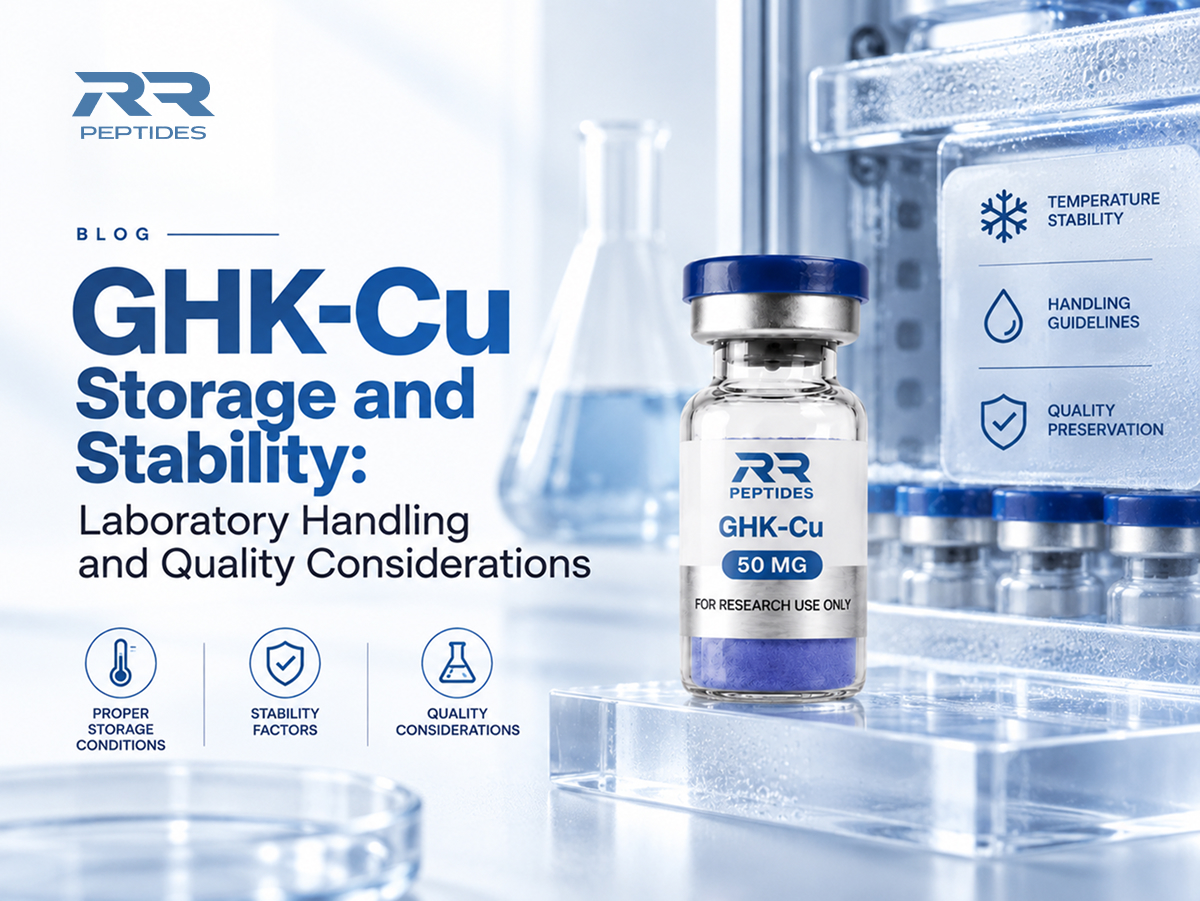
GHK-Cu is a copper-associated peptide complex investigated in biochemical, cellular, skin, and tissue-related research. Because experimental findings can depend on material identity, formulation, storage history, and analytical conditions, GHK-Cu storage and stability should be treated as part of laboratory quality control rather than as a separate administrative task.
For research laboratories, preserving sample integrity begins before an experiment starts. Researchers need to understand the characteristics of the material, document its batch information, follow appropriate supplier documentation, and maintain conditions that are consistent with the intended research workflow. RR Peptides provides research-focused information on peptide materials, laboratory considerations, and analytical quality to support researchers evaluating GHK-Cu.
In Canada, laboratories should also consider institutional procedures, laboratory safety requirements, procurement records, and applicable standards for their research setting. Commercial availability does not establish therapeutic authorization. This article focuses on laboratory and preclinical research considerations and does not provide instructions for human administration.
GHK-Cu storage and stability matter because peptide materials can be affected by environmental and handling conditions. Temperature, moisture, light exposure, formulation, container characteristics, preparation history, and repeated handling may influence the condition of a research sample.
The first step is to identify what material is being stored. GHK refers to glycyl-L-histidyl-L-lysine, while GHK-Cu refers to a copper-associated complex. Researchers should not assume that GHK, GHK-Cu, free copper compounds, or unrelated copper-containing materials have identical storage behavior.
GHK-Cu storage and stability should therefore be considered together with material characterization. A certificate of analysis may provide useful information about identity, purity, batch or lot number, and analytical testing. However, analytical information does not replace appropriate storage and handling practices.
Why stability affects research quality
A sample that has experienced an undocumented storage excursion may introduce uncertainty into an experiment. If an unexpected result occurs, researchers may need to determine whether it reflects the biological hypothesis, experimental conditions, or changes in the research material.
Important quality considerations include:
Material identity and batch information
Supplier storage recommendations
Container integrity
Temperature history
Moisture exposure
Light exposure
Preparation and handling history
Documentation of storage events
Factor
Why it matters
Documentation example
Identity
Confirms the material being studied
Batch or lot number
Temperature
May influence stability
Storage record
Moisture
Can affect dry material
Container condition
Light
May affect sensitive materials
Exposure notes
Handling
Can introduce variability
Preparation record
A documented approach to GHK-Cu storage and stability can make experimental interpretation more transparent. It also helps laboratories distinguish sample-related variables from biological variability.
Explore the research specifications and laboratory information available from RR Peptides for GHK-Cu 50mg.
Storage Conditions for Lyophilized GHK-Cu
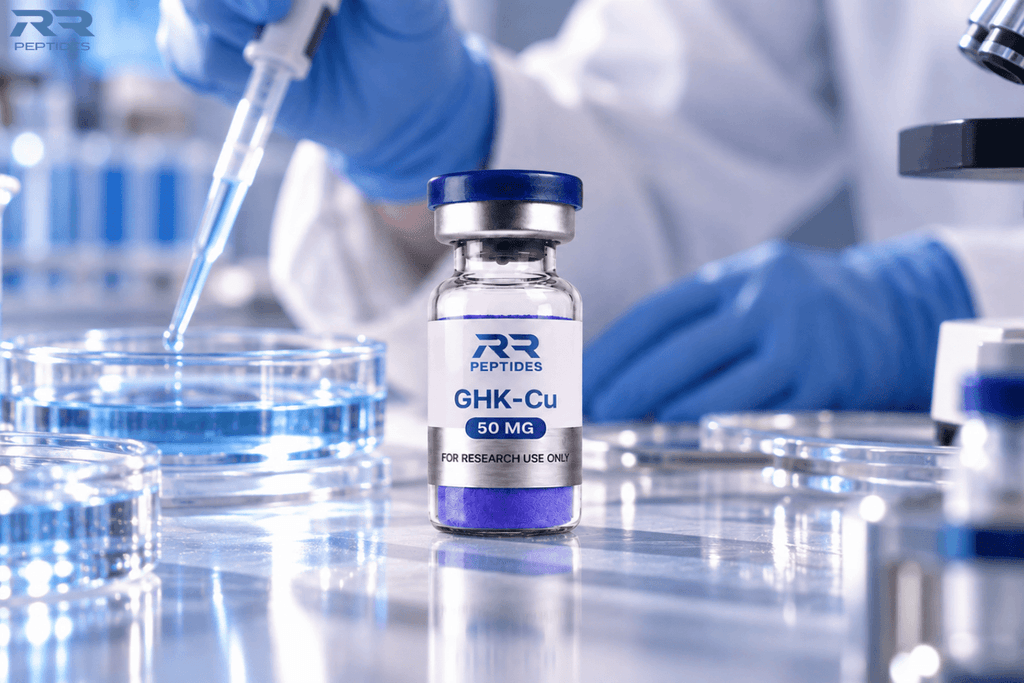
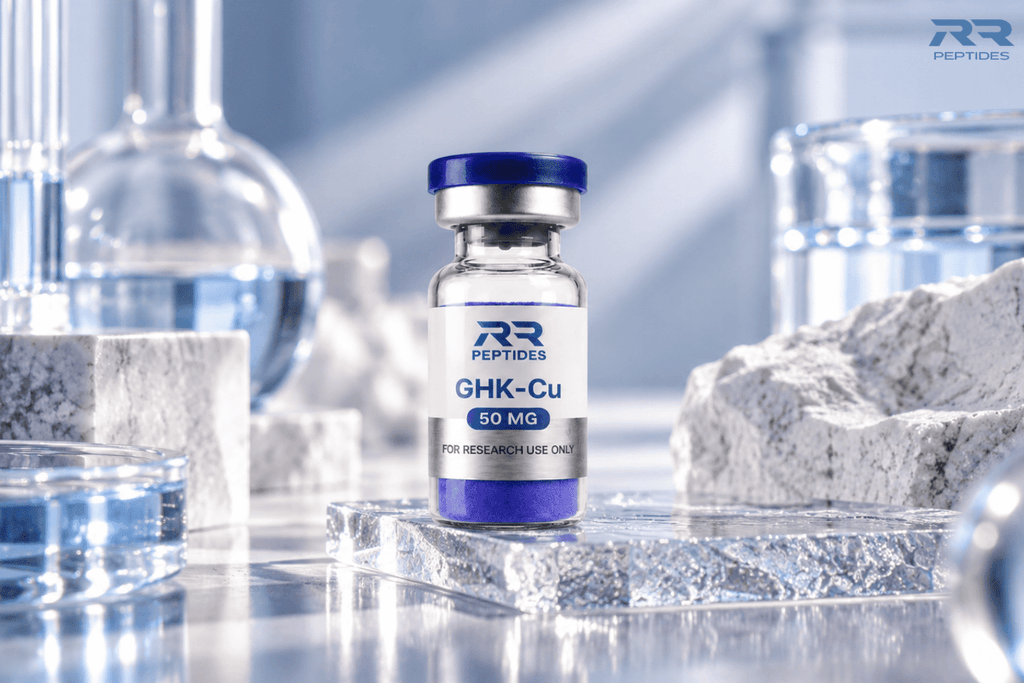
Lyophilized materials are commonly supplied as dry preparations intended to improve storage convenience and stability. However, lyophilization does not mean that a material is unaffected by its environment. Researchers should follow the storage conditions provided for the specific product and batch rather than assuming that all peptide materials have identical requirements.
GHK-Cu storage and stability should be assessed from the point at which the material enters the laboratory. Researchers can record the date received, batch number, stated storage conditions, container condition, and any relevant transport information.
Temperature management
Temperature is one of the key variables in peptide storage. The appropriate condition depends on the material, formulation, container, and supplier specifications. Researchers should therefore avoid applying a universal temperature rule to every GHK-Cu preparation.
Storage areas should be monitored according to laboratory procedures. If a temperature excursion occurs, the event should be documented rather than ignored. Researchers can then consult the relevant product documentation or quality records when deciding how the affected sample should be treated within the study.
Container and moisture protection
Dry peptide materials should be protected from unnecessary moisture exposure. Repeated opening of a container can introduce environmental humidity, particularly when samples are moved between storage and laboratory work areas.
Researchers should also inspect containers for visible damage, compromised seals, or other conditions that could affect sample integrity. GHK-Cu storage and stability records should include relevant observations when an unusual storage event occurs.
Storage consideration
Recommended research practice
Temperature
Follow product-specific documentation
Moisture
Minimize unnecessary exposure
Container
Keep appropriately closed and intact
Labeling
Maintain clear sample identification
Monitoring
Record relevant storage conditions
Excursions
Document and evaluate according to procedures
The goal is not simply to keep a sample at a particular temperature. Good storage practice creates a traceable history showing how the material was maintained before experimental use.
Effects of Temperature, Light, and Moisture
Environmental exposure can influence the stability of peptide materials. GHK-Cu storage and stability should therefore account for temperature, light, moisture, and the duration of exposure rather than considering any single factor in isolation.
Temperature changes may affect molecular processes and can become particularly relevant when samples experience repeated fluctuations. A stable storage environment is generally easier to document and evaluate than a sample exposed to uncontrolled changes.
Temperature fluctuations
A storage record can help identify whether a sample experienced an excursion. The significance of an excursion depends on the material and documented specifications. Researchers should not assume that a short deviation automatically renders a sample unusable, nor should they assume that every deviation is harmless.
Instead, the event should be recorded with the date, duration where known, affected batch, and available environmental information. This creates a basis for subsequent quality assessment.
Light exposure
Light sensitivity varies between chemical and biological materials. Researchers should follow product-specific documentation when light protection is specified. Unnecessary exposure can be minimized by limiting the time that a container remains outside its intended storage environment.
GHK-Cu storage and stability documentation can include notes about unusual or prolonged light exposure when such an event occurs.
Moisture and humidity
Moisture can be particularly relevant to dry materials because repeated exposure to humid air may alter the physical environment around the sample. Container opening practices therefore matter.
Researchers should avoid unnecessary opening and should use clean laboratory practices when accessing stored materials. The objective is to reduce uncontrolled environmental exposure while maintaining clear sample traceability.
Environmental factor
Potential concern
Research response
Temperature
Stability changes or excursions
Monitor and document
Light
Possible material sensitivity
Follow product documentation
Moisture
Changes to dry material
Minimize exposure
Repeated handling
Increased environmental exposure
Limit unnecessary access
These practices support GHK-Cu storage and stability by reducing avoidable variation before the sample reaches an experimental system.
Copper Complex Stability and Degradation Risks
GHK-Cu is not simply a peptide stored without consideration of its copper association. The chemical environment can influence metal coordination and the behavior of a peptide-associated complex. Researchers should therefore distinguish the properties of GHK-Cu from those of the uncomplexed GHK peptide or free copper compounds.
GHK-Cu storage and stability can depend on formulation, pH, concentration, solvent conditions, competing ligands, temperature, and other environmental variables. The exact influence of these factors depends on the experimental material and conditions.
Understanding degradation risk
The term degradation can refer to different types of change. A research material may experience chemical modification, changes in composition, physical changes, or other alterations that affect its characterization. Researchers should avoid assuming that an observed change in biological activity automatically identifies a specific degradation pathway.
Analytical methods can help investigate material quality. Depending on the research setting, laboratories may review chromatographic data, mass spectrometry, spectroscopic information, or other validated analytical approaches. The appropriate method depends on the material and research question.
Why analytical confirmation matters
GHK-Cu storage and stability cannot be established solely from appearance. A sample that looks unchanged may still require analytical assessment if there is a documented storage excursion or an unexpected experimental result.
Researchers should consider available certificates of analysis and batch information when reviewing sample quality. Where appropriate, analytical testing can help determine whether the material remains consistent with its documented characteristics.
Assessment
Research purpose
Identity testing
Confirms material identity
Purity analysis
Evaluates sample composition
Chromatography
Separates and assesses components
Mass spectrometry
Supports molecular characterization
Documentation review
Connects findings to batch history
Analytical characterization does not automatically establish biological activity or therapeutic suitability. It provides evidence about material characteristics that can improve the interpretation of experimental findings.
Explore the research specifications and laboratory information available from RR Peptides for GHK-Cu 50mg.
Laboratory Handling and Sample Documentation
Good handling practices are essential because storage conditions alone cannot guarantee sample integrity. Every movement from storage to experimental preparation creates an opportunity for environmental exposure, contamination, labeling errors, or undocumented changes.
GHK-Cu storage and stability should therefore be incorporated into the laboratory record. A useful record can connect the original batch with its storage history, preparation conditions, analytical information, and experimental use.
Handling practices
Researchers should establish procedures appropriate to their laboratory environment. These may include clear labeling, controlled access, clean work areas, suitable containers, and documentation of relevant preparation steps.
A practical laboratory workflow can include:
Verify material identity and batch information.
Review supplier documentation and stated storage conditions.
Inspect the container before use.
Record relevant storage or temperature information.
Document preparation and handling conditions.
Return remaining material to the appropriate storage environment.
Record unusual events or storage excursions.
GHK-Cu storage and stability documentation is particularly useful when a sample is used across multiple experiments. A consistent record can help researchers determine whether differences between experimental runs may be associated with the sample, preparation procedure, or biological model.
Sample labeling
Labels should provide enough information to distinguish one sample from another. Depending on laboratory procedures, records may include material name, batch or lot number, date received, storage location, preparation date, and responsible personnel.
Researchers should avoid relying only on memory for storage history. Written or electronic records provide a more reliable basis for reviewing an experiment months later.
Record
Example information
Material identity
GHK-Cu
Batch or lot
Supplier-provided identifier
Receipt date
Date received
Storage location
Assigned laboratory location
Storage history
Relevant environmental records
Preparation
Date and documented procedure
Experiment
Study or sample identifier
For Canadian research environments, documentation should align with institutional quality systems and applicable requirements. The exact requirements may vary by institution, study type, biological material, and laboratory setting.
Practical quality review
A practical review of GHK-Cu storage and stability can begin before the material is placed into routine laboratory use. Researchers can compare the received container with the supplier documentation, confirm the batch or lot identifier, and check whether the stated storage conditions can be maintained consistently. This first review creates a reference point for later GHK-Cu storage and stability decisions.
GHK-Cu storage and stability records should also distinguish normal storage from unusual events. For example, a temporary temperature excursion, damaged packaging, unexpected moisture exposure, or prolonged time outside controlled storage should be recorded separately rather than incorporated into ordinary storage history. Clear records make later interpretation more reliable.
Another useful consideration is sample segmentation. If a material will be used across several experiments, laboratories may establish an appropriate sample management procedure that limits unnecessary handling of the primary material. This can reduce repeated environmental exposure and make individual experimental records easier to trace.
GHK-Cu storage and stability can also be considered when reviewing results that differ between experimental runs. Researchers should compare batch information, preparation conditions, storage history, assay procedures, controls, and observation periods before attributing a difference to biological mechanisms.
When GHK-Cu storage and stability are reviewed alongside analytical characterization, researchers gain a clearer picture of sample quality. However, storage documentation cannot replace appropriate analytical testing when material identity or composition is uncertain.
For Canadian laboratories, GHK-Cu storage and stability procedures should fit the laboratory’s existing framework. Depending on the setting, records may be maintained through paper logs, electronic systems, inventory software, or other documentation. The important objective is traceability rather than a particular record format.
A consistent approach to GHK-Cu storage and stability also supports communication between researchers. When samples are transferred between personnel, laboratories, or experimental projects, documented batch information and storage history can reduce ambiguity. This is particularly valuable when results are compared over longer research periods.
Researchers should avoid assuming that successful storage guarantees identical experimental behavior. Biological assays remain sensitive to model selection, endpoint definition, controls, and experimental conditions. GHK-Cu storage and stability are therefore one component of reproducible research rather than a substitute for sound study design.
Explore the mechanisms, biological properties, and research findings of GHK-Cu in GHK-Cu Research: Mechanisms, Scientific Findings, and Laboratory Applications.
GHK-Cu storage and stability refers to the practices and environmental factors considered when maintaining a GHK-Cu research material before and during laboratory use. These include temperature, moisture, light, container integrity, formulation, handling, and documentation.
How should lyophilized GHK-Cu be stored?
Researchers should follow the storage conditions provided for the specific material and supplier documentation. There is no single universal storage condition that should automatically be applied to every GHK-Cu preparation.
Can temperature affect GHK-Cu?
Temperature can be an important stability variable for peptide materials. The significance of a particular temperature condition or excursion depends on the material, formulation, duration, and available quality information.
Does moisture matter for dry GHK-Cu?
Moisture can be relevant to dry materials. Researchers should minimize unnecessary exposure to humidity and maintain appropriate container practices according to laboratory procedures and product documentation.
Does light affect GHK-Cu stability?
Potential light sensitivity depends on the material and its formulation. Researchers should follow product-specific documentation and avoid unnecessary or prolonged exposure when light protection is recommended.
How can researchers evaluate a storage excursion?
The event should be documented with available information such as date, duration, environmental conditions, and affected batch. Researchers can then review supplier documentation and applicable laboratory quality procedures.
Does appearance prove stability?
No. Visual appearance alone cannot establish chemical identity, purity, or stability. Analytical information may be required when material quality is uncertain.
Why is batch documentation important?
Batch information connects an experimental sample to its material history. It can help researchers compare results, investigate unexpected findings, and distinguish sample variability from biological variability.
What should Canadian laboratories consider?
Canadian laboratories should follow applicable institutional procedures, laboratory safety practices, supplier documentation, and requirements relevant to their research setting. Human or animal research may involve additional oversight.
Final Research Perspective
GHK-Cu storage and stability are important components of research quality because sample history can influence how experimental findings are interpreted. Temperature, moisture, light, formulation, container integrity, preparation, and handling should be considered alongside material identity and analytical characterization.
A reliable workflow begins with clear sample identification and appropriate documentation. Researchers should record batch information, review storage requirements, monitor relevant conditions, document excursions, and maintain traceability throughout the experimental process.
For Canadian laboratories, these practices should be integrated with institutional procedures and applicable research requirements. RR Peptides provides research-focused information on peptide materials, laboratory handling, analytical characterization, and scientific evidence to help researchers evaluate GHK-Cu within an appropriate experimental context.
Ultimately, GHK-Cu storage and stability should not be treated as a simple storage question. They are part of a broader quality framework connecting material characterization, environmental conditions, laboratory handling, documentation, and reproducibility. Careful records can help researchers interpret results more transparently and identify potential sources of experimental variability.
Disclaimer: All products and compounds discussed are intended strictly for laboratory and research purposes. This article is provided for educational and informational purposes only. This article is not medical advice, therapeutic guidance, or instructions for human administration.
3 Comments
This article provides a useful overview of the factors that can influence GHK-Cu stability during storage. I found the discussion of environmental conditions particularly helpful for understanding why consistent handling matters when working with peptide research materials.
I appreciate the practical focus on storage and stability rather than making broad claims about GHK-Cu. Understanding how storage conditions may affect sample integrity is an important part of maintaining reliable laboratory research materials.
The storage considerations are easy to overlook, so I found this overview particularly useful. Paying attention to environmental exposure, handling practices, and consistency can help researchers better understand the factors that may affect peptide stability.
Comments are closed.
×
Subscribe & Get 10% Off!
Enter your email address below to subscribe to our newsletter and receive an instant 10% OFF discount coupon code sent directly to your inbox!
Thank you for subscribing! Your 10% discount coupon has been sent to your email. Please check your inbox!




This article provides a useful overview of the factors that can influence GHK-Cu stability during storage. I found the discussion of environmental conditions particularly helpful for understanding why consistent handling matters when working with peptide research materials.
I appreciate the practical focus on storage and stability rather than making broad claims about GHK-Cu. Understanding how storage conditions may affect sample integrity is an important part of maintaining reliable laboratory research materials.
The storage considerations are easy to overlook, so I found this overview particularly useful. Paying attention to environmental exposure, handling practices, and consistency can help researchers better understand the factors that may affect peptide stability.