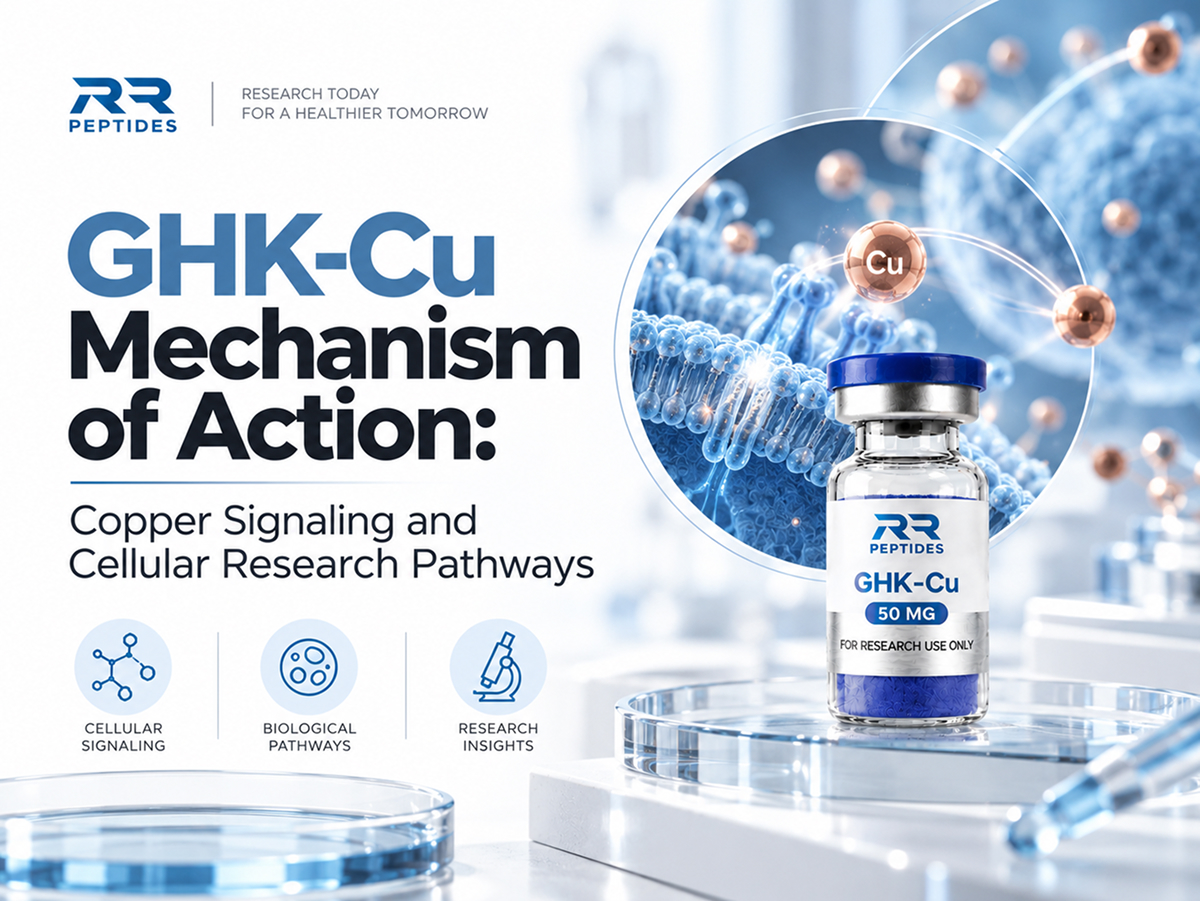
Understanding how GHK-Cu is investigated requires separating its chemical identity from the biological observations reported in experimental models. The GHK-Cu mechanism of action is not a single pathway, but a research framework involving copper coordination, cellular signaling, gene expression, extracellular matrix biology, and tissue-associated processes.
GHK-Cu has attracted scientific interest because the GHK tripeptide can associate with copper and because experimental studies have examined several cellular and molecular endpoints. However, observations vary with material characterization, model selection, experimental conditions, controls, and analytical methods. Researchers should interpret mechanistic findings within the system in which they were generated.
RR Peptides provides research-focused information about peptide materials, laboratory models, analytical characterization, and scientific evidence. For Canadian researchers, this information can help place GHK-Cu studies within a documented research workflow. Commercial availability should not be interpreted as proof of therapeutic authorization, efficacy, or human safety.
The GHK-Cu mechanism of action is best understood as a collection of proposed and experimentally investigated biological processes rather than one confirmed sequence of events. GHK-Cu is commonly described as a copper-associated complex involving glycyl-L-histidyl-L-lysine, or GHK, and copper. GHK itself is a small tripeptide consisting of glycine, histidine, and lysine.
The chemical form of the material matters because free GHK, GHK-Cu, and other copper-containing compounds are not automatically interchangeable. A mechanistic study should identify the material being tested before interpreting downstream cellular observations. This distinction is especially important when results from different publications or suppliers are compared.
Researchers may investigate the GHK-Cu mechanism of action through biochemical assays, cell culture, reconstructed tissues, ex vivo systems, or animal models. Each approach provides different information. A biochemical assay can examine molecular interactions, while a cell model can evaluate signaling or gene expression. More complex models can provide additional biological context but also introduce more variables.
A framework for mechanistic research
A useful mechanistic study generally connects four elements:
Material identity and analytical characterization
Defined molecular or cellular pathway
Appropriate experimental model and controls
Measurable endpoint linked to the research question
The strength of a proposed mechanism depends on how consistently these elements support the same interpretation. A change in one biomarker may be compatible with a pathway hypothesis, but it does not necessarily establish a complete mechanism.
Research element
Why it matters
Material identity
Defines what was actually tested
Copper association
Establishes chemical context
Experimental model
Determines biological relevance
Molecular endpoint
Provides measurable evidence
Controls
Help separate treatment-related observations
Replication
Tests reproducibility
The GHK-Cu mechanism of action should therefore be interpreted as evidence accumulated across defined experimental systems. Interpret findings within model limits.
Explore the research specifications and laboratory information available from RR Peptides for GHK-Cu 50mg.
Copper Binding and Cellular Signaling
Copper binding is central to understanding the GHK-Cu mechanism of action because GHK contains functional groups capable of participating in metal coordination. The histidine residue is particularly relevant to copper association, although the behavior of the complex depends on its chemical environment.
Factors such as pH, copper availability, competing ligands, concentration, solvent conditions, and formulation can influence metal coordination. For this reason, a mechanistic interpretation should include enough information about experimental conditions to make the findings meaningful.
Copper is involved in many biological processes, including enzyme activity, redox chemistry, and cellular homeostasis. Researchers therefore need to distinguish observations associated with a peptide-copper complex from effects produced by free copper or unrelated copper compounds.
Copper coordination and experimental interpretation
The GHK-Cu mechanism of action may be studied by examining whether copper association changes measurable molecular or cellular properties. Analytical techniques can provide information about identity, composition, purity, or molecular characteristics, while biological assays can investigate downstream observations.
No single analytical method answers every question. Chromatographic methods may provide separation and purity information, mass spectrometry may support molecular identification, and spectroscopic approaches can provide additional chemical information. Method selection should match the research question.
Researchers can also examine cellular signaling endpoints such as changes in protein abundance, gene expression, cellular morphology, migration, or pathway-associated markers. These observations may help develop mechanistic hypotheses but should be interpreted with appropriate controls.
Factors affecting interpretation
Several variables can influence copper-related experiments:
Chemical environment and pH
Copper concentration and availability
Competing ligands or molecules
Peptide concentration and formulation
Assay conditions and analytical method
These variables matter because a pathway observation may depend on the surrounding experimental environment. Reproducing a finding therefore requires more than using the same peptide name; researchers should also consider material characterization and experimental conditions.
In a laboratory setting, the GHK-Cu mechanism of action should be connected to a defined hypothesis. If researchers investigate a signaling marker, they should establish why that marker is relevant, what controls are required, and what alternative explanations could produce the same observation.
For Canadian laboratories, maintaining batch records, certificates of analysis, preparation records, storage information, and experimental conditions can strengthen traceability. These practices support reproducibility but do not establish clinical effectiveness or regulatory approval.
Gene expression provides another route for investigating the GHK-Cu mechanism of action. Researchers may examine whether exposure to GHK-Cu is associated with changes in selected genes involved in extracellular matrix biology, cellular signaling, inflammatory pathways, oxidative processes, or other research areas.
Gene-expression data can be informative because they provide molecular measurements that may help identify biological responses. However, changes in messenger RNA do not automatically demonstrate corresponding changes in protein abundance, cellular function, or tissue-level outcomes.
Interpreting gene-expression findings
A well-designed experiment should define which genes are being examined and why they are relevant to the research hypothesis. Researchers should also document the model, exposure conditions, controls, sampling period, analytical method, and normalization approach.
The GHK-Cu mechanism of action should not be inferred from gene-expression changes alone. Stronger mechanistic interpretation may emerge when gene-expression observations are consistent with protein-level measurements, cellular changes, or other independent endpoints.
Endpoint
What it may contribute
Gene expression
Molecular response information
Protein abundance
Evidence closer to functional pathways
Cell morphology
Observable cellular response
Migration
Functional cellular behavior
Matrix markers
Structural or remodeling context
Multiple endpoints
Broader mechanistic interpretation
Researchers may compare treated and control conditions, evaluate dose-related patterns where scientifically appropriate, and replicate observations across experiments. The objective is not simply to find a statistically different marker but to determine whether the pattern supports the biological question.
From molecular signal to mechanism
The distinction between association and causation is particularly important. If GHK-Cu exposure is associated with a change in gene expression, the result can support a hypothesis without proving that GHK-Cu directly regulates every process downstream of that gene.
A stronger interpretation may require multiple experimental approaches. For example, researchers could examine gene expression together with protein abundance and cellular phenotype. Consistency across independent endpoints can provide more context than an isolated molecular measurement.
The GHK-Cu mechanism of action may therefore be described with different levels of confidence depending on the evidence. Evidence remains model-dependent. These categories should not be presented as equivalent.
For researchers in Canada, appropriate institutional procedures and documentation are important when studies involve biological samples, animals, or other regulated research settings. Requirements can vary according to the institution, study design, and research material.
Extracellular Matrix and Tissue Remodeling Pathways
Extracellular matrix research is one important area used to investigate the GHK-Cu mechanism of action. The extracellular matrix provides structural support and participates in cellular communication, adhesion, migration, and tissue organization. Researchers may therefore examine matrix-associated markers when studying GHK-Cu.
Fibroblast models are relevant to extracellular matrix research because these cells contribute to the production and organization of matrix components. Experimental endpoints can include cell morphology, migration, collagen-associated markers, gene expression, and other measures related to matrix biology.
Matrix-related research endpoints
Studies may evaluate:
Collagen-associated markers
Fibroblast behavior
Cellular morphology and migration
Matrix-related gene expression
Protein-level measurements
Tissue-associated structural observations
These endpoints do not all provide the same type of evidence. A molecular marker may indicate a change in signaling, while a cellular observation may provide information about phenotype. Researchers should avoid treating one endpoint as proof of every proposed tissue process.
The GHK-Cu mechanism of action in matrix research can therefore involve several connected research questions. Scientists may ask whether the material is associated with changes in cellular signaling, whether those changes correspond with matrix-related markers, and whether observations are reproducible in more complex models.
Tissue remodeling research
Tissue remodeling involves multiple cell types, matrix components, signaling molecules, and environmental factors. A simplified cell model cannot reproduce all of these interactions. Reconstructed tissue systems, ex vivo models, and animal studies can add complexity but also introduce additional variables.
Researchers should distinguish between observations made in isolated cells and findings generated in tissue or animal models. An effect observed in a cell culture system does not automatically establish the same response in a living organism.
The GHK-Cu mechanism of action should consequently be linked to the model and endpoint used in each study. This approach helps avoid combining evidence from different experimental systems as though it represented one uniform biological mechanism.
Research model comparison
Model
Research value
Key limitation
Cell culture
Controlled cellular observations
Simplified environment
Reconstructed tissue
Adds structural context
Limited systemic biology
Ex vivo tissue
Preserves tissue characteristics
Limited viability and duration
Animal model
Greater biological complexity
Species differences
For Canadian researchers, documenting model conditions, material identity, batch information, controls, and analytical methods can make tissue-related findings easier to reproduce and compare.
Explore the research specifications and laboratory information available from RR Peptides for GHK-Cu 50mg.
Current Mechanistic Evidence and Limitations
Current research provides several areas in which GHK-Cu can be investigated mechanistically, including copper coordination, cellular signaling, gene expression, extracellular matrix biology, and tissue-associated processes. However, the available evidence should be separated into observations from specific experimental models rather than presented as one established mechanism.
The GHK-Cu mechanism of action remains dependent on experimental context. Differences in peptide identity, purity, formulation, concentration, model, exposure conditions, analytical method, and endpoint can influence results.
Evidence should be interpreted by model
Cell-based findings can provide useful mechanistic information but have limited biological complexity. Animal studies can provide broader context but may not translate directly to humans. In vitro biochemical observations can clarify molecular properties but do not independently establish tissue-level effects.
Researchers should also distinguish between mechanistic evidence and therapeutic evidence. A pathway observation may explain how a material behaves in a model without demonstrating that the same process produces a clinically meaningful outcome.
Material characterization and reproducibility
Analytical characterization is another important limitation. If researchers do not know whether two studies used materially comparable samples, differences in findings may reflect sample variability rather than biology.
A useful quality record may include identity, purity, batch or lot number, storage history, preparation method, analytical results, controls, and experimental conditions. Such documentation helps researchers identify sources of variability.
The GHK-Cu mechanism of action should therefore be evaluated alongside material quality and study design. A mechanistic conclusion is more informative when the tested material is clearly characterized and the experiment has appropriate controls and reproducible endpoints.
For Canadian laboratories, researchers should follow institutional policies, applicable safety procedures, and relevant Canadian requirements. Where human or animal research is involved, appropriate institutional oversight should be obtained.
Another consideration is the relationship between copper availability and experimental conditions. Researchers should distinguish peptide-complex behavior from changes caused by the chemical environment. Variables such as pH, competing ligands, formulation, and concentration can influence responses. Documenting these conditions helps determine whether an observation is associated with the material or system.
Mechanistic studies can benefit from comparing multiple endpoints within the same model. Researchers may examine gene expression and protein measurements, cellular morphology, or extracellular matrix markers. When observations support a consistent pattern, interpretation provides stronger context than a single measurement. This does not eliminate uncertainty, but it can improve reasoning.
Reproducibility is important when comparing GHK-Cu findings across laboratories. Differences in sample preparation, analytical characterization, storage, controls, or observation periods can influence results. Researchers should report conditions and avoid combining findings from different systems without considering these variables. Documentation helps determine whether results reflect biological variation, methodological differences, or both.
What current evidence cannot establish
Existing laboratory research cannot by itself establish that GHK-Cu is safe or effective for human treatment. Preclinical findings can inform scientific hypotheses, but translation requires evidence appropriate to the specific clinical question.
This distinction is important for accurate scientific communication. Research-focused information should describe what was measured, in which model, under which conditions, and what limitations remain.
RR Peptides provides research-focused information to help laboratories evaluate peptide materials, analytical considerations, and scientific literature. The GHK-Cu mechanism of action remains model-dependent. Clear documentation strengthens the GHK-Cu mechanism of action interpretation. Researchers should use product documentation and primary research alongside institutional procedures when designing experiments.
Explore the mechanisms, biological properties, and research findings of GHK-Cu in GHK-Cu Research: Mechanisms, Scientific Findings, and Laboratory Applications.
FAQ About the GHK-Cu Mechanism of Action
What does the GHK-Cu mechanism of action refer to?
The GHK-Cu mechanism of action refers to biological processes investigated in relation to the copper-associated GHK complex. Research has examined copper coordination, cellular signaling, gene expression, extracellular matrix biology, and tissue-associated observations.
Does GHK-Cu have one confirmed mechanism?
No single pathway should automatically be treated as a universal mechanism. Findings depend on the material, model, endpoint, and experimental design. The GHK-Cu mechanism of action is better discussed in relation to specific evidence.
Can gene expression prove a mechanism?
No. Gene-expression changes provide molecular evidence but do not independently establish causation or functional outcomes. The GHK-Cu mechanism of action requires appropriate interpretation of multiple endpoints when stronger mechanistic evidence is needed.
Why are extracellular matrix studies relevant?
The extracellular matrix contributes to tissue structure, cell adhesion, migration, and cellular communication. These processes provide useful research contexts for examining the GHK-Cu mechanism of action, particularly in fibroblast and tissue-associated models.
Why is analytical characterization important?
Identity and purity information help establish what material was tested. Without adequate characterization, researchers may not know whether differences between studies reflect biology or sample variability. This is essential when evaluating the GHK-Cu mechanism of action across laboratories.
Can laboratory findings be treated as medical advice?
No. Laboratory findings are not instructions for human administration and should not be presented as proof of therapeutic efficacy or safety. The GHK-Cu mechanism of action remains a research topic that requires evidence appropriate to each biological question.
Final Research Perspective
The GHK-Cu mechanism of action is best examined through a combination of chemical characterization, copper-binding research, cellular signaling, gene-expression analysis, extracellular matrix studies, and appropriate experimental models.
For researchers, the strongest approach is to define the scientific question first, characterize the material, select a suitable model, establish controls, and use endpoints that directly address the hypothesis. Reproducible documentation can then help distinguish biological observations from material or methodological variability.
For Canadian laboratories, appropriate institutional procedures, safety practices, sample traceability, and applicable requirements should be considered when planning research. Where biological, animal, or other regulated research is involved, the relevant institutional oversight should be followed.
RR Peptides provides research-focused information for laboratories exploring peptide materials, mechanisms, analytical quality, and experimental applications. Reviewing material specifications and relevant scientific evidence before a study can help researchers build a clearer and more reproducible experimental framework. Explore research-focused information from RR Peptides when evaluating GHK-Cu materials and laboratory study considerations.
Disclaimer: All products and compounds discussed are intended strictly for laboratory and research purposes. This article is provided for educational and informational purposes only. This article is not medical advice, therapeutic guidance, or instructions for human administration.
3 Comments
This article provides a clear introduction to the proposed mechanism of action of GHK-Cu. I found the discussion of copper binding and the biological pathways being investigated particularly useful for understanding the research background of this peptide complex.
I liked the mechanism-focused approach because it explains GHK-Cu beyond simply describing its composition. Understanding how the peptide-copper complex interacts with biological pathways provides useful context when reviewing the available research.
The explanation of GHK-Cu’s proposed biological activity makes the topic easier to follow. I especially appreciate the distinction between mechanisms being investigated in research and conclusions that would require stronger evidence.
Comments are closed.
×
Subscribe & Get 10% Off!
Enter your email address below to subscribe to our newsletter and receive an instant 10% OFF discount coupon code sent directly to your inbox!
Thank you for subscribing! Your 10% discount coupon has been sent to your email. Please check your inbox!




This article provides a clear introduction to the proposed mechanism of action of GHK-Cu. I found the discussion of copper binding and the biological pathways being investigated particularly useful for understanding the research background of this peptide complex.
I liked the mechanism-focused approach because it explains GHK-Cu beyond simply describing its composition. Understanding how the peptide-copper complex interacts with biological pathways provides useful context when reviewing the available research.
The explanation of GHK-Cu’s proposed biological activity makes the topic easier to follow. I especially appreciate the distinction between mechanisms being investigated in research and conclusions that would require stronger evidence.