How is peptide purity tested? In laboratory settings, researchers typically use analytical techniques such as high-performance liquid chromatography (HPLC) or ultra-high-performance liquid chromatography (UHPLC) to separate peptide-related components and estimate chromatographic purity. Mass spectrometry (MS) can then provide complementary molecular-mass information that supports peptide identity.
However, a purity percentage alone does not provide a complete assessment of a peptide sample. Researchers must also consider sample preparation, chromatographic conditions, identity verification, impurity profiles, batch information, and the limitations of each analytical method. International analytical guidance likewise treats identity and impurity/purity testing as distinct analytical attributes and emphasizes method characteristics such as specificity, accuracy, precision, and working range where applicable.
For researchers reviewing peptide materials and laboratory documentation, RR Peptides provides research-focused peptide information and resources.
How Is Peptide Purity Tested?
In most laboratory workflows, peptide purity testing begins with preparing a representative sample and analyzing it using a chromatographic method. Reverse-phase HPLC is widely used because it can separate the intended peptide from many peptide-related impurities according to differences in physicochemical interactions with the chromatographic system.
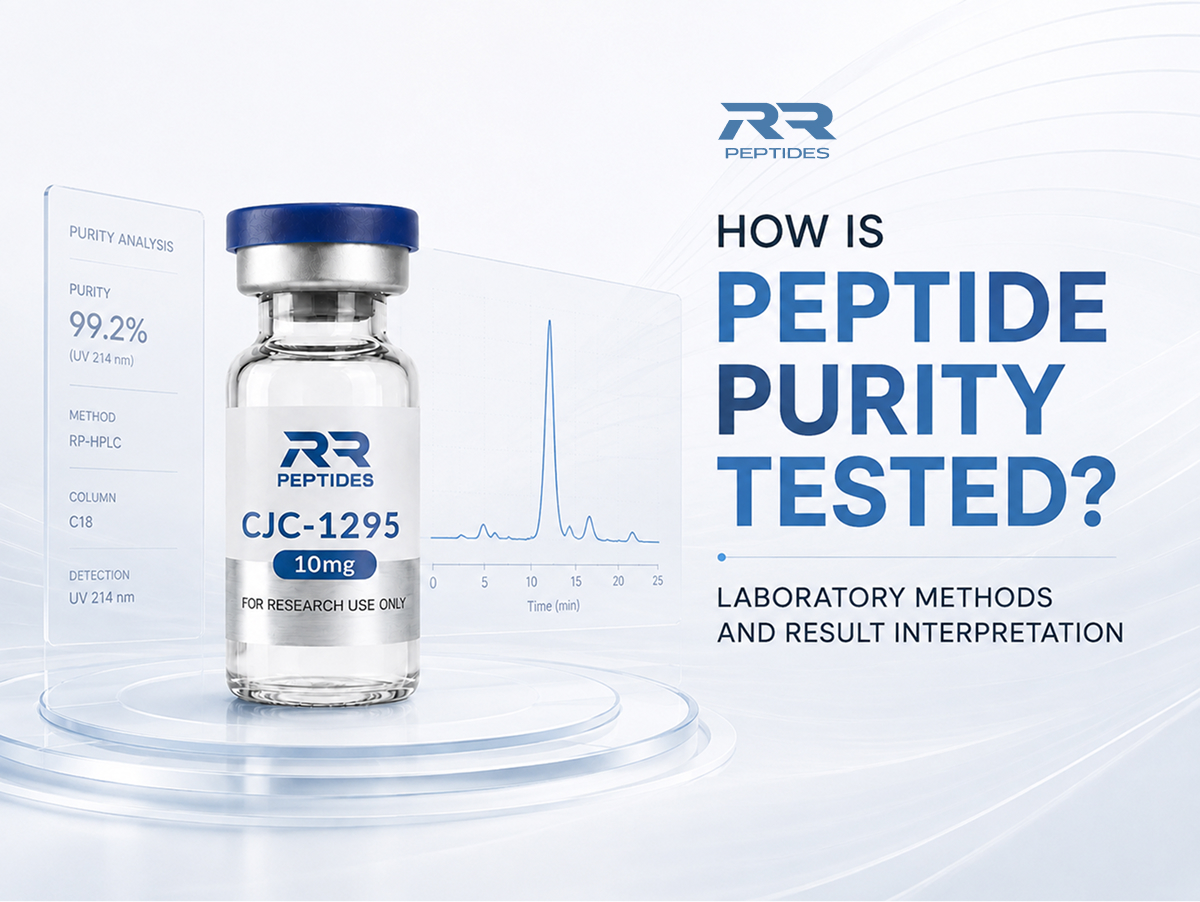
Researchers then examine the resulting chromatogram. The main peptide-related component usually produces a dominant peak, while additional detectable components may appear as smaller peaks. Laboratories can integrate these peaks to calculate the relative chromatographic purity of the sample.
Mass spectrometry is often used alongside chromatography. Rather than simply providing another purity percentage, MS measures mass-to-charge information and helps researchers determine whether the observed material is consistent with the expected molecular mass of the peptide.
A simplified analytical workflow may therefore look like this:
Stage
Primary Purpose
Sample preparation
Produce a suitable analytical sample
HPLC or UHPLC
Separate peptide-related components
Peak integration
Estimate relative chromatographic purity
Mass spectrometry
Support molecular identity
Data review
Interpret purity and impurity information
Batch documentation
Connect results to the tested material
Importantly, laboratories may use different analytical procedures depending on the peptide, research objective, equipment, and quality attributes under investigation.
Purity and Identity Are Different Measurements
One of the most important concepts when answering how is peptide purity tested is the distinction between purity and identity.
Purity asks how much of the relevant detected chromatographic response corresponds to the main component compared with other detectable components.
Identity asks whether that material is consistent with the peptide researchers expect to analyze.
For example, an HPLC chromatogram could theoretically contain one dominant peak. That result would indicate that one component dominates under the analytical conditions, but it would not independently prove that the component has the intended molecular identity.
Therefore, researchers often combine separation techniques with an orthogonal analytical method such as mass spectrometry.
What Can Affect Peptide Purity?
Understanding how is peptide purity tested also requires considering impurities that may originate from synthesis, purification, storage, or degradation.
Potential examples include:
deletion sequences
truncated peptides
oxidation products
chemically modified sequences
synthesis-related by-products
degradation products
The type and quantity of these components can vary considerably between peptide sequences. Consequently, researchers should evaluate individual analytical results rather than assuming that every peptide produces the same chromatographic profile.
Preparing Peptide Samples for Laboratory Analysis
Understanding how is peptide purity tested begins before the sample enters an HPLC or mass spectrometer, because reliable results depend on proper sample preparation. Sample preparation can influence peak shape, reproducibility, detection, and ultimately the interpretation of laboratory data.
When investigating how is peptide purity tested, researchers need preparation conditions appropriate for both the peptide and the analytical method.
Sample Solubility
When considering how is peptide purity tested, the peptide must first be prepared in a solvent system compatible with the analytical procedure.
Peptides differ in physicochemical properties. Sequence composition, hydrophobicity, charge, and aggregation tendencies can affect solubility. Consequently, a preparation method suitable for one peptide may not be appropriate for another.
Poor dissolution can create problems because the analyzed solution may not accurately represent the original sample. In addition, visible or microscopic particulate material can interfere with analytical procedures.
Therefore, researchers should use validated or otherwise suitable preparation conditions rather than assuming that all peptides behave similarly in solution.
Sample Concentration
When examining how is peptide purity tested, analytical concentration also matters because it can influence detection and peak interpretation.
A sample that is too concentrated can exceed the useful response range of the analytical system, potentially affecting peak shape or quantitation. Conversely, a concentration that is too low may make minor components difficult to detect reliably.
ICH Q2(R2) describes the importance of establishing a suitable working range in which an analytical procedure provides reliable results. Although this guidance applies to regulated analytical procedure validation rather than serving as a universal protocol for research peptides, the principle illustrates why analytical concentration and method suitability matter.
Avoiding Sample Degradation
When considering how is peptide purity tested, sample preparation should also minimize unintended chemical changes before analysis.
Depending on the peptide, factors such as temperature, light, oxygen exposure, pH, moisture, and prolonged time in solution can potentially affect stability.
If degradation occurs during preparation, the resulting chromatogram may reflect both the original sample and changes introduced during handling.
For this reason, laboratories should document relevant preparation conditions when reproducibility is important.
Representative Sampling
A complete answer to how is peptide purity tested also depends on whether the analytical sample accurately represents the material being characterized.
This becomes particularly important when comparing batches or investigating changes over time. Clear sample identification, lot numbers, preparation dates, and analytical records improve traceability.
A useful laboratory record may therefore document the peptide, batch number, sample preparation conditions, analytical method, test date, and resulting chromatographic or mass-spectrometric data.
Explore quality research peptides in Canada at RR Peptides
Using HPLC to Measure Peptide Purity
High-performance liquid chromatography is one of the principal methods used when researchers ask how is peptide purity tested in the laboratory?
For peptide analysis, reverse-phase HPLC is commonly used to separate the intended peptide from detectable related components.
How HPLC Separation Works
To understand how is peptide purity tested with HPLC, researchers first need to understand how the sample moves through the chromatographic column.
Different components interact differently with these phases. Consequently, they can travel through the column at different rates and appear at different retention times.
The detector records the compounds as they leave the column, producing a chromatogram.
A typical chromatogram may show:
one dominant peptide-related peak
smaller secondary peaks
retention times
detector responses
integrated peak areas
Researchers use these data to assess the chromatographic composition of the sample.
Calculating Relative Purity
To better understand how is peptide purity tested, researchers can use a simplified peak-area calculation:
Relative purity (%) = Main relevant peak area ÷ Total relevant integrated peak area × 100
Suppose the primary peak represents approximately 98% of the relevant integrated chromatographic response. Under those specific analytical conditions, the laboratory may report approximately 98% chromatographic purity. However, this percentage needs careful interpretation.
What 99% HPLC Purity Actually Means
When evaluating how is peptide purity tested, a COA reporting 99% HPLC purity generally indicates that the primary peak accounts for approximately 99% of the relevant detected chromatographic area.
It does not automatically mean that 99% of the total vial weight consists of the intended peptide.
A lyophilized material may also contain water, counterions, salts, or other components that do not correspond directly to the same chromatographic peak-area calculation.
Therefore:
Chromatographic purity ≠ absolute peptide content
Researchers should keep these concepts separate when reviewing laboratory results.
Factors That Influence HPLC Results
Understanding how is peptide purity tested also requires recognizing that HPLC results depend on more than the sample itself. Analytical conditions can affect separation and detection.
Relevant factors may include:
Analytical Factor
Why It Matters
Column
Influences chromatographic separation
Mobile phase
Affects peptide retention and elution
Gradient
Influences separation across the run
Flow rate
Affects retention and separation
Detector conditions
Influence recorded response
Sample concentration
Can affect analytical performance
Integration
Influences reported peak areas
Consequently, comparing purity percentages from different laboratories requires caution if they use different methods.
HPLC vs UHPLC
UHPLC follows the same broad chromatographic principles but uses instrumentation designed for higher pressures and often smaller particle sizes.
Under appropriately developed conditions, UHPLC can offer efficient separation and faster analysis. Nevertheless, UHPLC is not automatically more accurate simply because the equipment is newer or operates at higher pressure.
The analytical procedure must still be suitable for its intended purpose.
Confirming Peptide Identity with Mass Spectrometry
When explaining how is peptide purity tested, chromatography provides important purity information, while mass spectrometry adds complementary evidence about molecular identity. This is where mass spectrometry becomes particularly valuable.
What Mass Spectrometry Measures
Mass spectrometry measures the mass-to-charge ratio, commonly written as m/z, of ions generated from a sample.
Researchers can calculate the theoretical molecular mass expected from a peptide’s amino-acid sequence. They can then compare this expected value with experimental MS data.
Agreement between expected and observed mass information supports the conclusion that the analyzed material is consistent with the intended peptide.
Why MS Complements HPLC
HPLC and mass spectrometry answer related but different questions.
Method
Main Analytical Question
HPLC/UHPLC
What components can the method separate, and what is their relative chromatographic response?
Mass spectrometry
Is the observed molecular mass consistent with the expected material?
LC-MS
What mass information is associated with chromatographically separated components?
Therefore, an analytical report containing both HPLC and MS data can provide more information than a purity percentage alone.
Understanding Multiple Charge States
When examining how is peptide purity tested with mass spectrometry, researchers should remember that peptides can produce ions carrying more than one electrical charge.
As a result, a mass spectrum may display multiple signals corresponding to different charge states of the same molecule. This does not automatically mean that each signal represents a separate impurity.
Researchers must interpret the spectrum according to the ionization technique, expected molecular mass, charge states, and analytical conditions.
LC-MS Analysis
Liquid chromatography–mass spectrometry combines chromatographic separation and mass analysis.
First, LC separates components in the sample. Then, the mass spectrometer analyzes compounds as they leave the chromatographic system.
This combination can help researchers investigate the mass characteristics associated with the main chromatographic component and, where detectable and interpretable, additional components.
However, LC-MS does not eliminate the need for suitable analytical procedures and careful interpretation.
Explore quality research peptides in Canada at RR Peptides
Interpreting Laboratory Purity Results
Understanding how peptide purity is tested is only part of the process. Researchers must also determine what the resulting numbers actually demonstrate.
A reported purity value should be interpreted alongside the method, chromatogram, identity data, batch information, and other relevant documentation.
Review the Chromatogram
When available, researchers should review the chromatogram rather than relying only on the percentage printed on a COA.
Important questions include:
Is there a clearly dominant peak?
Are additional peaks visible?
Are the peaks adequately separated?
Is retention time provided?
Are peak areas reported?
Are analytical conditions identified?
The presence of a chromatogram allows researchers to see more of the analytical evidence underlying the final percentage.
Compare HPLC and MS Results
To understand how is peptide purity tested, HPLC and mass spectrometry should be viewed as complementary rather than duplicate tests.
Instead, they provide complementary information.
For example:
HPLC result: 98.7% chromatographic purity MS result: observed molecular-mass information consistent with the expected peptide
Together, these results provide evidence about both chromatographic composition and molecular identity.
Nevertheless, they still do not automatically establish every other quality attribute.
Evaluate Batch-Specific Documentation
Understanding how is peptide purity tested also requires researchers to connect analytical results with the actual batch used in an experiment.
A Certificate of Analysis may contain:
peptide or product identification
batch or lot number
testing date
HPLC purity result
mass spectrometry result
analytical method
laboratory information
Batch-specific testing is important because different production lots can potentially differ in their analytical characteristics.
Understand the Limits of a Purity Percentage
A high purity result can provide useful information, but researchers should avoid interpreting it as a complete quality guarantee.
For example, a chromatographic purity percentage does not independently establish:
absolute peptide content
sterility
endotoxin levels
residual solvent concentrations
water content
long-term stability
suitability for every experimental application
Each of these attributes requires appropriate analytical evidence when relevant.
Does Higher Purity Always Mean Better Quality?
Not necessarily in isolation.
For example, a sample reported as 99.5% pure but supported by limited documentation may provide less analytical confidence than a 98.5% sample supported by a batch-specific chromatogram, identity testing, transparent methods, and appropriate supporting data.
Researchers should therefore evaluate the quality of the analytical evidence, not simply choose the largest percentage.
Why Method Suitability Matters
A complete answer to how is peptide purity tested must also consider whether the analytical procedure is suitable for the attribute it claims to evaluate.
ICH Q2(R2), for example, treats identity testing and quantitative impurity testing as different categories and discusses performance characteristics such as specificity, accuracy, precision, detection or quantitation capability, and working range as appropriate to the analytical objective. It also notes that limitations in the specificity of one analytical procedure can sometimes be addressed with supporting procedures.
For peptide research, this reinforces an important principle: researchers should interpret results in the context of the method used to generate them.
Peptide Purity Testing Considerations in Canada
When explaining how is peptide purity tested, purity refers to how much of the relevant chromatographic response corresponds to the main component compared with other detectable components.
Health Canada regulates health products sold in Canada and requires regulated products to meet applicable safety, efficacy, and quality requirements before authorization. The agency also oversees areas including manufacturing, testing, packaging, importing, and distribution within its regulatory mandate.
Importantly, Health Canada specifically warns that products marketed as For Research Use Only – Not for Human Consumption are not automatically legal or exempt from regulatory requirements simply because they carry that label.
Therefore, a high HPLC purity percentage or an MS identity result should not be interpreted as evidence that a product is authorized for human use in Canada.
For laboratory research, researchers should consider two separate questions:
Analytical question: Does the available testing adequately characterize the material for the intended experiment?
Regulatory question: What Canadian rules apply to the material, its representation, and its intended use?
Maintaining this distinction supports more accurate interpretation of laboratory quality documentation.
Common Mistakes When Reviewing Peptide Testing
When learning how is peptide purity tested, researchers should also recognize several common mistakes that can lead to overinterpretation of analytical results.
Treating Purity as Peptide Content
A 99% HPLC result generally describes relative chromatographic peak area under specified conditions. It does not automatically establish that 99% of the physical material is peptide.
Using HPLC Alone as Proof of Identity
A dominant HPLC peak provides chromatographic information but does not independently establish molecular identity.
Mass spectrometry or another suitable complementary technique can provide additional identity evidence.
Ignoring the Tested Batch
A COA from one production lot should not automatically be assumed to represent every subsequent batch.
Researchers should look for batch-specific documentation whenever possible.
Focusing Only on the Highest Percentage
Small differences such as 98%, 99%, and 99.5% should not be evaluated without considering the analytical methods and supporting documentation.
A well-documented result can be more informative than a higher percentage with little supporting evidence.
Laboratories commonly use HPLC or UHPLC to separate the main peptide-related component from detectable impurities and estimate relative chromatographic purity. Mass spectrometry can then provide complementary molecular-mass information to support identity.
Why is HPLC used for peptide purity testing?
HPLC can separate peptide-related components according to their chromatographic behaviour. Researchers can integrate the resulting peaks and estimate the relative proportion of the main detected component.
What does 99% HPLC purity mean?
It generally means that the main integrated peak accounts for approximately 99% of the relevant detected chromatographic peak area under the specified method conditions. It does not necessarily mean that 99% of total sample mass consists of peptide.
How does mass spectrometry confirm peptide identity?
Researchers compare experimentally observed mass-to-charge information with the molecular mass expected from the intended peptide. Agreement supports molecular identity, although additional characterization may be appropriate depending on the research objective.
Is HPLC or mass spectrometry more important?
They serve different purposes. HPLC primarily supports chromatographic separation and purity assessment, while mass spectrometry provides molecular-mass information. Using complementary methods can provide a more complete analytical picture.
What is LC-MS peptide testing?
LC-MS combines liquid chromatography and mass spectrometry. Chromatography first separates components, after which mass spectrometry provides mass information about the compounds detected during the analysis.
Can peptide purity results differ between laboratories?
Yes. Differences in analytical procedures, columns, mobile phases, detector conditions, sample preparation, integration, and other variables can affect reported results. Researchers should consider the methods when comparing data.
Does high purity guarantee peptide quality?
No. Purity is one analytical characteristic. Identity, content, impurity profile, stability, batch traceability, and other quality attributes may also be relevant.
Should researchers check the COA?
Yes. A batch-specific COA can provide useful information about purity, identity testing, analytical methods, test dates, and the material analyzed. However, researchers should also consider the underlying analytical evidence when available.
Does laboratory purity testing mean a peptide is approved in Canada?
No. Analytical testing and regulatory authorization are separate. Health Canada requires health products within its regulatory scope to satisfy applicable requirements before they can be legally sold, and research-use labelling alone does not create an exemption.
Final Thoughts
So, how is peptide purity tested? Laboratories commonly begin with appropriate sample preparation, use HPLC or UHPLC to separate peptide-related components and estimate chromatographic purity, and apply mass spectrometry to provide complementary molecular-mass and identity information.
However, the final purity percentage should never be interpreted in isolation. Researchers should examine the chromatogram, analytical method, MS results, batch information, COA, and any additional quality attributes relevant to their experimental objective. A 99% purity claim becomes considerably more informative when researchers understand how the laboratory generated and verified that number.
For Canadian laboratories, researchers should also distinguish analytical characterization from regulatory authorization. Laboratory purity or identity results do not independently demonstrate that a material is authorized for therapeutic or human use in Canada.
Explore RR Peptides for additional research peptide information, laboratory-focused resources, and product documentation.
Disclaimer: All products and compounds referenced are intended strictly for laboratory and research purposes only. This content is provided for informational and educational purposes and is not intended as medical advice or to diagnose, treat, cure, or prevent any disease.
3 Comments
Really clear explanation of how peptide purity is tested. I especially liked that the article breaks down the analytical process instead of simply focusing on a stated purity percentage. It would be interesting to see a comparison of HPLC and mass spectrometry and what each method can tell researchers.
This was a helpful introduction to the methods used to assess peptide purity. The explanation makes it easier to understand why proper analytical testing matters when evaluating research materials. I’d be interested in learning more about how researchers interpret the results from different testing techniques.
I found the research-focused approach particularly helpful. Understanding how purity results are generated makes it easier to evaluate quality claims rather than simply taking a percentage at face value. It would be great to see a follow-up covering common limitations or sources of variation in peptide testing.




Really clear explanation of how peptide purity is tested. I especially liked that the article breaks down the analytical process instead of simply focusing on a stated purity percentage. It would be interesting to see a comparison of HPLC and mass spectrometry and what each method can tell researchers.
This was a helpful introduction to the methods used to assess peptide purity. The explanation makes it easier to understand why proper analytical testing matters when evaluating research materials. I’d be interested in learning more about how researchers interpret the results from different testing techniques.
I found the research-focused approach particularly helpful. Understanding how purity results are generated makes it easier to evaluate quality claims rather than simply taking a percentage at face value. It would be great to see a follow-up covering common limitations or sources of variation in peptide testing.